-White.avif)
-Color.avif)
Cloud Native Security: Securing Distributed Apps
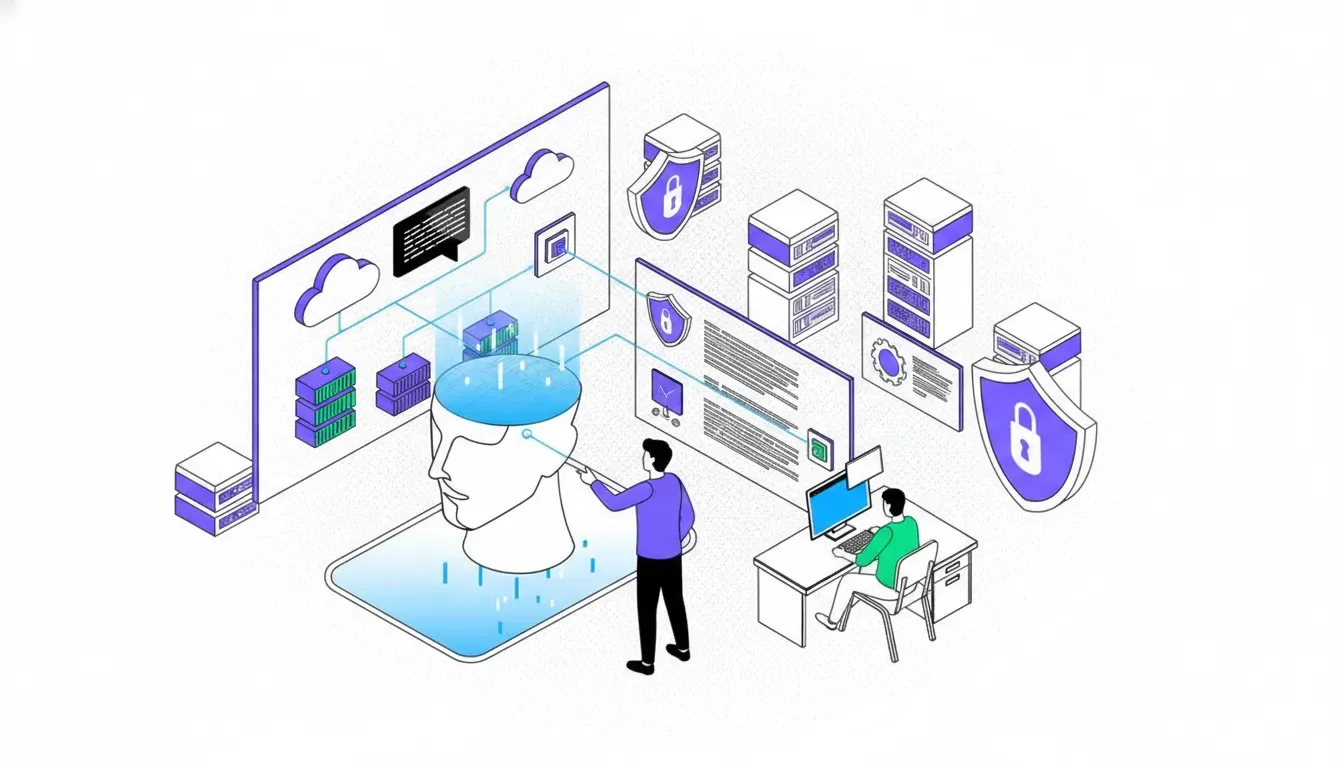
Cloud native security is the discipline of protecting applications that are built from distributed services, APIs, containers, managed cloud resources, and automated delivery pipelines. The challenge is not securing one server or one perimeter. It is proving that identities, configurations, service-to-service paths, runtime behavior, and remediation controls continue to work as the application changes.
Learn how Penti approaches cloud penetration testing across modern infrastructure.
What is cloud native security?
Cloud native security is a continuous, systems-level approach to reducing risk in applications that use cloud infrastructure, microservices, containers, APIs, and automation. It combines preventive controls, identity-aware access, configuration validation, attack-surface visibility, runtime detection, penetration testing, and evidence that confirms important fixes actually worked.
In a traditional application, teams can often draw a relatively stable trust boundary around a data center, network segment, or server fleet. In a cloud native application, the boundary moves with every deployment, workload, service account, third-party integration, and infrastructure-as-code change. Security therefore has to follow the workload and its relationships, not just the network location.
The goal is not to eliminate every possible finding before software ships. The goal is to make risk visible, limit blast radius, validate the controls that matter, and produce reliable evidence for engineering leaders, security teams, customers, and auditors.
Why distributed applications change the threat model
Distributed applications create more security decisions and more paths between them. A request may cross an edge gateway, identity provider, API gateway, service mesh, container workload, queue, database, and cloud control plane. Each hop can introduce a permission, configuration, or trust assumption that is difficult to see from a single scanner or dashboard.
Three characteristics make the model especially demanding:
- Many identities: users, workloads, service accounts, CI runners, cloud roles, and third-party integrations may all call the same application.
- Fast change: deployments, autoscaling, feature flags, and infrastructure-as-code can alter exposure without a traditional infrastructure change window.
- Chained impact: a low-severity weakness in one service may become a serious issue when combined with an overprivileged identity, an exposed secret, or an overly permissive network path.
A useful threat model follows a transaction across its full path. Ask which identity initiated it, which service accepted it, which authorization decision was made, what data was reachable, and whether the same path could be abused from a different tenant, role, region, or workload.
How does the shared responsibility model apply?
The cloud provider secures the underlying platform, but the customer remains responsible for how cloud services are configured and used. The exact split varies by service model. In practice, the customer must still protect identities, data, application logic, permissions, secrets, workload configuration, and the connections between those components.
Google Cloud's shared responsibility guidance makes the distinction concrete: providers secure the underlying infrastructure, while customers remain responsible for access policies and the data they store. Similar principles apply across AWS, Microsoft Azure, and other cloud environments, even though the control names differ.
| Security area | Provider contribution | Customer responsibility |
|---|---|---|
| Physical infrastructure | Facilities, hardware, and foundational platform controls | Select appropriate regions, services, and resilience options |
| Identity and access | Identity and policy capabilities | Role design, least privilege, MFA, service identity, and review |
| Application layer | Managed runtime protections where offered | Code, APIs, authorization logic, dependencies, and tenant isolation |
| Data | Encryption features and managed storage controls | Classification, access, retention, key use, and data exposure testing |
| Configuration | Secure defaults and security recommendations may be available | Network rules, public exposure, secrets, logging, and drift management |
Shared responsibility is not a reason to assign blame after an incident. It is a map of control ownership. A strong program turns that map into named owners, testable requirements, and evidence that shows whether each control is operating as designed.
1. Make identity the first security boundary
Identity is the most important control plane in a distributed application because network location rarely explains whether a request should be trusted. Cloud native security should evaluate who or what is calling, what it is allowed to do, which resource it needs, and whether the request context changes the decision.
Start by inventorying identities rather than only listing hosts. Include human users, service accounts, workload identities, cloud roles, CI/CD runners, integration tokens, break-glass accounts, and credentials issued to vendors. For each identity, document ownership, purpose, permissions, expiration, authentication method, and the resources it can reach.
Then test the authorization model from both expected and unexpected paths. A service should not gain broad database access simply because it runs inside a trusted cluster. A token intended for one tenant should not retrieve another tenant's records. A deployment identity should not retain production mutation rights when it only needs to publish an artifact.
- Use short-lived credentials and workload identity where the platform supports them.
- Separate deployment, runtime, administrative, and emergency roles.
- Apply least privilege to actions and resources, not just to user groups.
- Review machine identities after service ownership or architecture changes.
- Test authorization failures, tenant boundaries, token replay, and privilege escalation.
NIST's zero trust architecture guidance reinforces this identity-centered approach: access decisions should not rely on implicit trust based only on network location or ownership.
2. Control configuration, secrets, and the software supply chain
Configuration is executable security policy. A permissive storage bucket, public management endpoint, broad security group, weak Kubernetes setting, or exposed environment variable can change the effective risk of an otherwise well-designed application.
Cloud native security programs should define secure configuration baselines for cloud accounts, clusters, containers, APIs, data stores, and CI/CD systems. Store those baselines as code when possible, review changes through version control, and alert when production drifts from the approved state.
Secrets deserve a separate control path. Do not treat a secret manager as a complete solution if applications, logs, build artifacts, images, or pull requests can still expose the value. Inventory where secrets are created, stored, copied, used, rotated, and revoked. Test whether a compromised workload can read secrets outside its intended scope.
Supply-chain controls should cover:
- Dependency and container-image provenance
- Base image age and known vulnerable components
- Build runner permissions and isolation
- Artifact signing, verification, and promotion rules
- Pull request and deployment protections
- Secrets scanning before code and artifacts reach production
The important question is not whether a tool reports a misconfiguration. It is whether the organization can explain its business impact, assign an owner, fix it without creating a new exposure, and verify the fix in the environment that matters.
3. Map APIs and east-west attack paths
External entry points are only one part of the attack surface. In a distributed application, internal APIs and service-to-service calls can become an attacker highway after an initial compromise. A secure design therefore maps both north-south traffic entering the platform and east-west traffic moving between services.
Build an inventory of public, private, authenticated, administrative, partner, and machine-to-machine APIs. Tie each endpoint to its owning service, data classification, authentication method, authorization policy, rate limit, logging coverage, and expected consumers. Include asynchronous paths such as queues, webhooks, event buses, and scheduled jobs.
For every important flow, test the controls that prevent abuse:
- Can an unauthenticated caller reach a sensitive function?
- Can an authenticated caller access another user's or tenant's object?
- Can a low-privilege service invoke an administrative action?
- Can a message, webhook, or job be replayed or forged?
- Can a compromised service pivot to data stores or control-plane APIs?
- Are errors, traces, and logs exposing tokens or sensitive data?
NIST's Guidelines for API Protection for Cloud-Native Systems treats API security as a lifecycle problem, from discovery and risk analysis through protection and monitoring. That framing is useful because an API inventory that is accurate only at launch is not an inventory for a continuously changing application.
4. Add runtime visibility and limit blast radius
Pre-deployment checks cannot show everything that happens after workloads start, credentials change, or traffic takes an unexpected route. Runtime visibility connects cloud events, workload behavior, identity activity, API requests, network flows, and application logs so teams can identify a suspicious sequence rather than isolated alerts.
A practical runtime control set includes:
- Centralized audit logs for identity, cloud control-plane, and administrative activity
- Workload and container telemetry with useful ownership metadata
- Network flow visibility for unexpected east-west communication
- Detection for abnormal privilege use, secret access, and data movement
- Alert routing that includes service owner, environment, and severity context
- Tested isolation and credential-revocation procedures
Visibility only reduces risk when it leads to a decision. Define what should happen when a production service accesses a new data store, a deployment identity changes permissions, or a workload begins communicating with a previously unseen domain. Containment should be designed before the incident, with safe fallbacks for systems that cannot simply be shut down.
Penti's attack surface management capabilities are relevant to this problem because asset discovery and exposure monitoring help security teams maintain an up-to-date view across cloud, on-premises, and hybrid environments.
5. Verify security continuously, not only at release time
Continuous verification means checking whether important security assumptions still hold as the application, identities, dependencies, and cloud resources change. It combines automated checks with targeted adversarial testing and human review for the paths where context and business logic matter.
A balanced verification program can operate at several stages:
| Stage | Useful checks | Evidence to retain |
|---|---|---|
| Build | Dependencies, secrets, image provenance, infrastructure policy | Build results, exceptions, artifact identity |
| Deploy | Configuration drift, permissions, exposure, admission policy | Approved change and environment snapshot |
| Runtime | Identity use, network flows, behavior, data access | Logs, alerts, investigation records |
| Adversarial test | Exploitability, chained paths, authorization, business logic | Reproduction steps, impact, remediation guidance |
| Retest | Fix validation and regression testing | Before-and-after evidence and residual risk |
Automation provides scale and repeatability, while certified human testers can validate complex attack chains and business logic that static rules may miss. This is particularly important when a cloud native weakness depends on the interaction between an API, a service identity, a tenant boundary, and a cloud permission.
How should teams prioritize cloud native security remediation?
Prioritize remediation by exploitable business risk, not by the number of findings or a severity label alone. A finding should move up the queue when it combines meaningful exposure, a reachable attack path, valuable data or control-plane access, weak compensating controls, and a realistic route to impact.
For each material issue, record:
- The affected asset, service, identity, tenant, and environment
- The initial access or precondition required
- The attack path and permissions gained
- The data, business process, or control plane at risk
- The recommended fix and the owner accountable for it
- The deadline, exception decision, and residual risk
- The exact retest method and evidence required for closure
Do not close a finding because a ticket changed state. Close it when the control was changed and a retest shows the original path no longer works. If the fix cannot be implemented safely, document the accepted risk, compensating control, owner, and review date. That evidence is more useful than a dashboard with a lower count but no proof of what changed.
A practical cloud native security checklist
Use this checklist as a starting point for a distributed application review. It is intentionally broader than a cluster-hardening checklist because cloud native risk crosses application, identity, infrastructure, and operational boundaries.
- Map users, workloads, services, APIs, data stores, queues, cloud accounts, and third-party connections.
- Assign an owner and business purpose to every important identity and exposed asset.
- Test least privilege, tenant isolation, token lifetime, role transitions, and privilege escalation.
- Validate cloud, container, API, network, secret, and CI/CD configuration against approved baselines.
- Track public exposure and unexpected changes across cloud, on-premises, and hybrid environments.
- Test east-west attack paths, webhook authenticity, queue permissions, and service-to-service authorization.
- Centralize useful audit evidence and confirm that logs support investigation and remediation.
- Run continuous vulnerability checks plus targeted penetration tests for chained and business-logic risk.
- Retest material fixes and preserve before-and-after evidence that a reviewer can understand.
- Review the threat model after major architecture, identity, provider, or data-flow changes.
Frequently asked questions
What is the difference between cloud security and cloud native security?
Cloud security is the broader discipline of protecting cloud infrastructure, data, identities, and workloads. Cloud native security applies those principles to applications designed around distributed services, APIs, containers, automation, and managed services, where security boundaries and dependencies change frequently.
Does cloud native security replace penetration testing?
No. Preventive controls and continuous monitoring reduce exposure, but penetration testing validates whether an attacker can chain weaknesses across APIs, identities, services, and cloud permissions. A mature program uses automated checks for scale and targeted human validation for complex or high-impact paths.
Is Kubernetes security the same as cloud native security?
No. Kubernetes security is an important part of cloud native security when a workload uses Kubernetes, but the wider discipline also covers application authorization, API design, cloud IAM, infrastructure-as-code, secrets, data stores, CI/CD, service meshes, runtime behavior, and hybrid connections.
How often should a cloud native application be tested?
Test continuously at the points where change occurs, then use deeper adversarial testing after major architecture, identity, data-flow, or exposure changes. The right cadence depends on risk, release velocity, regulatory commitments, and how quickly the team can investigate and remediate findings.
What evidence shows that a security fix worked?
Useful evidence connects the original finding to the affected asset, the implemented change, and a repeatable retest. Capture the before state, the control or code change, the after state, test results, residual risk, owner approval, and any follow-up monitoring needed to detect regression.
Talk with Penti about validating cloud native attack paths across your distributed application.
.avif)