-White.avif)
-Color.avif)
AI-Driven API Penetration Testing Software
Penti uncovers exploitable weaknesses in your REST APIs, GraphQL endpoints, and SOAP web services with an AI-driven API penetration testing platform backed by certified penetration testers. Continuous API pentesting pinpoints multi-step attack chains, business logic flaws, and authorization failures across every API endpoint. Need same-day pentest results? Click below to start.


API Penetration Testing Overview
APIs are now the largest and fastest-growing attack surface for modern applications. Penti's API penetration testing tool combines agentic AI security testing with expert validation by certified penetration testers to identify vulnerabilities across every API endpoint, delivering pentest results faster than traditional engagements.
With our API penetration testing solution, Penti continuously evaluates API endpoints across REST, GraphQL, and SOAP-based web services, delivering ongoing API security assessment and detecting security vulnerabilities that traditional point-in-time reviews miss. The platform integrates directly into CI/CD pipelines, enabling continuous testing throughout the API lifecycle. Agentic AI surfaces common and advanced weaknesses, while certified penetration testers validate findings, uncover business logic flaws, and reduce false positives.
What Penti Helps You Achieve
APIs (application programming interfaces) change fast, and so do the security threats and API security risks that target them. Penti's API security testing aligns with your business priorities and integrates into modern development workflows.
Reduce API-Driven Breach Risk
.avif)
Protect Customer Trust and Revenue

Enable Secure Development at Scale

API Discovery and Inventory
AI-Driven Testing and Analysis
Manual Validation by Experts
Authorization and Data Access Testing
Reporting and Response Validation
Remediation and Continuous Testing
How Penti Works
Penti delivers a structured, repeatable API penetration testing process designed for modern engineering environments and continuous testing across the API lifecycle.
Sample API Penetration Testing Reports
Penti runs many pentest engagement types. Below are two common formats for Web Application & API testing that both cover full API surfaces: a manual pentest by certified penetration testers, and an Agentic AI-assisted pentest with continuous re-testing. Each ends with a structured report your dev team can act on the same day.

Manual Web Application & API Penetration Testing Report
A manual pentest by certified testers covering REST, GraphQL, SOAP, and microservices APIs.
Inside the report:
- Scope & Methodology: shows every API tested and the frameworks the report maps to. Compliance coverage includes OWASP API Top 10, PCI DSS, and NIST SP 800-95, matching what auditors typically ask for.
- Testing Phases: covers the 8-step systematic approach. Dedicated API Security, Authentication, and Authorization testing means nothing gets skipped.
- Manual Assessment Results: documents every vulnerability on its own page. Each entry explains what the vuln is, how attackers exploit it (reproduction steps and API payloads), how to fix it (BAD vs GOOD code snippets), and which compliance controls it violates.
- Prioritized Remediation: fixes grouped into Tier 1 (24-48 hours) and Tier 2 (1-2 weeks). Each tier lists findings with business impact, technical effort, and specific recommended actions.
- Re-testing: retest schedule (Tier 1 within 1 week, Tier 2 within 2 weeks) plus the Successful Retests table with retest date and verified status.
- Disclosure & Certifications: legal engagement scope and tester credentials. Includes OSCP, BSCP, CEH, and cloud/API security certifications.
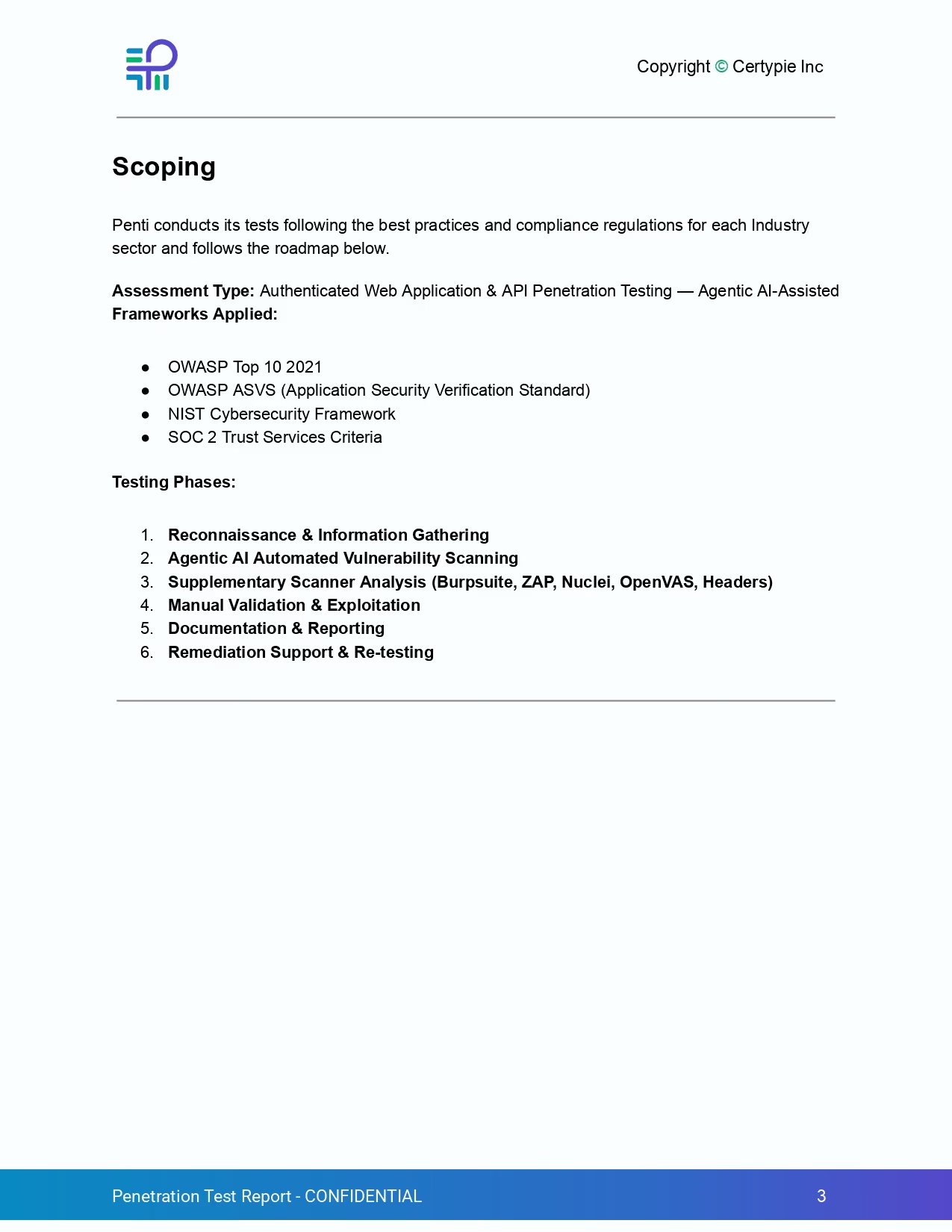
Agentic AI Web Application & API Penetration Testing Report
An Agentic AI-assisted pentest covering the full Web App and API surface, with certified experts reviewing every finding.
Inside the report:
- Scope & Methodology: shows API endpoints covered and framework alignment. Coverage maps to OWASP Top 10 2021, ASVS, NIST CSF, and SOC 2 Trust Services Criteria.
- Testing Cadence: covers how continuous coverage works. Agentic AI runs on a scheduled basis while supplementary scanners run quarterly, layering coverage without gaps.
- Scanner Factors & Risk Rating: each finding is scored via OWASP Likelihood × Impact plus a Confidence rating (Certain/Firm/Tentative), separating actionable findings from ones that need further investigation.
- Findings Table: side-by-side attribution across scanner sources tags each vulnerability to the specific scanner that caught it.
- Prioritized Remediation: fixes grouped into Tier 1 (24-48 hours), Tier 2 (1-2 weeks), and Tier 3 (1-3 months). Each tier lists findings with business impact and specific recommended actions.
- Re-testing: retest schedule (Tier 1 within 1 week, Tier 2 within 2 weeks, Tier 3 within 1 month) plus continuous re-testing on the Agentic AI engine.
- Disclosure & Certifications: legal scope and tester credentials, including OSCP, CPTS, CEH, and cloud security certifications.
API types Penti tests
Penti's API penetration testing tool covers every modern API surface. Each engagement documents the exact endpoints tested and the tools used against each API type.
.svg)
REST APIs
.svg)
GraphQL APIs

SOAP-based web services
.svg)
Microservices architectures
Tools Penti uses in every API engagement
Penti is the API penetration testing platform that consolidates multiple API pentesting tools and vulnerability scanning outputs into one single API report. Every Penti API engagement uses an industry-standard toolkit of security testing tools, with results captured and presented in a unified deliverable that documents the exact tools used, payloads, and reproduction steps for each API finding.
Proxy & interception
Fuzzing & discovery
Injection testing
Authentication & authorization
API testing
Specialized tools
Penti Agentic AI
Automated scanners
Penetration testing types done by Penti

Cloud pentesting

Mobile pentesting

Network pentesting

External network pentesting

Internal network pentesting
.svg)
Web app pentesting

Penetration testing for IoT
Compliance-driven pentests by Penti

Manual vs Agentic AI API Pentest
Penti runs API pentests two ways depending on your scope and cadence.
| Manual API Pentest | Agentic AI API Pentest | |
|---|---|---|
| Assessment Type | Manual Web Application & API Penetration Testing | Authenticated Web Application & API Penetration Testing, Agentic AI-Assisted |
| How testing runs | Performed manually by certified penetration testers | Penti's Agentic AI autonomously executes attack chains, with certified human review at every stage (Human-in-the-Loop) |
| Cadence | Engagement with defined scope and testing window | Continuous: Agentic AI runs on a scheduled basis, supplementary scanners run quarterly |
| Testing phases | 8 phases: Information Gathering & Reconnaissance, Authentication & Session Management Testing, Authorization & Access Control Testing, Input Validation & Injection Testing, Business Logic Testing, API Security Testing, Documentation & Reporting, Remediation Support | 6 phases: Reconnaissance & Information Gathering, Agentic AI Automated Vulnerability Scanning, Supplementary Scanner Analysis, Manual Validation & Exploitation, Documentation & Reporting, Remediation Support & Re-testing |
| Tool stack | Full manual toolkit: Burp Suite Pro, OWASP ZAP, Caido, mitmproxy, ffuf, Gobuster, Arjun, ParamSpider, SQLMap, Ghauri, Commix, tplmap, XXEinjector, XSStrike, Nuclei, Postman, GraphQL Voyager, JWT/OAuth/SAML analysis tools, custom Burp extensions | Penti Agentic AI engine + supplementary scanners (Burp Suite Pro, OWASP ZAP, Nuclei, OpenVAS, Securily Headers Scanner) + manual toolkit still available for exploit validation |
| Framework coverage | OWASP Top 10 2021, OWASP ASVS, OWASP API Security Top 10, PCI DSS, NIST SP 800-95 | OWASP Top 10 2021, OWASP ASVS, NIST Cybersecurity Framework, SOC 2 Trust Services Criteria |
| Findings depth | Deep manual exploit chains with code snippets (BAD vs GOOD), reproduction payloads, testing process | Side-by-side findings table per scanner source, manually validated findings, OWASP Risk Rating with Confidence (Certain / Firm / Tentative) |
| Prioritized remediation | Per-finding Tier 1 (24–48 hours) and Tier 2 (1–2 weeks), plus a medium-term (1–3 months) recommendations summary for broader hardening | Tier 1 (24–48 hours), Tier 2 (1–2 weeks), Tier 3 (1–3 months) |
| Re-testing | Tier 1 within 1 week of fix, Tier 2 within 2 weeks, included in original scope | Tier 1 within 1 week, Tier 2 within 2 weeks, Tier 3 within 1 month + continuous re-testing on the Agentic AI engine (scheduled basis) |
| Best for | Compliance audits, point-in-time security validations, and scoped engagements | Continuous coverage as your APIs evolve, with scheduled re-testing across many endpoints |
Industries we work with


The Value of Penti’s API Penetration Testing Tool
Penti delivers measurable API security outcomes and audit-ready evidence instead of endless static reports, from discovery through remediation.
Accurate Results You Can Trust
Continuous Visibility Across APIs
Built for Modern Engineering Teams
One Platform, Total Coverage
Trusted by Security and Engineering Leaders
From CISOs and AppSec leaders to DevOps and platform teams, organizations rely on Penti to secure APIs that power critical business operations.


Penti's service is a game changer for our compliance needs. The insights we gained were invaluable for our team. Doing this well is crucial for our compliance targets and key in advancing our strategic initiatives.


The integration between Penti, our system, and third parties like Vanta is exceptional. I would also like to mention that their response times are extremely fast!

Penti has been like having an experienced and nimble Security Engineer on staff. They have outlined issues in our platform and guided us towards implementations and fixes that allow for us to ensure we are treating our users data with the utmost care.
What Sets Penti Apart
API security threats (injection attacks, machine-in-the-middle attacks, and DDoS) evolve rapidly, and traditional pentesting struggles to keep up. Penti launches in minutes, so you can ensure your API security is functioning as intended.
Built for Modern APIs

Penti's agentic AI simulates real-world attacks tailored to modern REST, GraphQL, and SOAP API architectures, catching patterns of malicious attacks that signature-based automated security tools miss.
Findings Validated by Human Experts
Every critical finding is reviewed by certified penetration testers for accuracy, business context, and exploitability before it reaches your team.
Continuous, Not Point-in-Time
Unlike traditional penetration testing, Penti provides runtime insights through continuous testing, with findings surfaced in a single dashboard your team already uses.
Actionable Remediation Steps
Penti not only reports findings, it prioritizes them by risk level and business impact so your team can act on findings the same day testing concludes.
.avif)
See Penti in action
Continuous agentic AI pentesting across Disco's Web apps, APIs, cloud, and network perimeter, validated by certified human experts.










FAQ
What is API penetration testing?
API penetration testing is a security assessment in which certified penetration testers (or AI agents backed by human review) simulate real-world attacks against a web application's APIs to find security vulnerabilities like broken authorization, SQL injection, business logic flaws, and authentication bypass. The methodology typically aligns with the OWASP API Security Top 10 and OWASP ASVS.
How is Penti different from traditional API testing?
Penti combines agentic AI penetration testing with expert validation by certified penetration testers, delivering continuous API security insights instead of one-time, point-in-time assessments. Every finding is validated through a Human-in-the-Loop process before it reaches your team.
Does Penti support modern API architectures?
Yes. Penti supports REST, GraphQL, and SOAP-based web services, plus microservices architectures. Testing covers API specifications, complex authentication mechanisms, and multi-step attack chains across every API endpoint.
Can Penti identify business logic flaws?
Yes. Manual testing goes beyond automated testing, focusing on business logic testing, authorization bypasses, mass assignment, excessive data exposure, and misuse scenarios that automated vulnerability scanners often overlook.
How does Penti help with compliance?
Penti supports compliance efforts by providing evidence of ongoing, rigorous security testing and identifying security vulnerabilities aligned with the OWASP API Top 10, plus per-finding Compliance Impact mapping to SOC 2, ISO 27001, PCI DSS, HIPAA, GDPR, and NIST.
Will Penti find undocumented APIs?
Yes. API discovery identifies undocumented and legacy endpoints, hidden endpoints, and internal APIs that increase your attack surface.
How often are APIs tested?
Testing is continuous. Penti's Agentic AI runs on a scheduled cadence, catching new vulnerabilities as APIs change without waiting for an annual engagement.
Is Penti suitable for fast-moving development teams?
Absolutely. Penti integrates into CI/CD workflows and the software development lifecycle, supporting rapid development without adding friction. Automated retesting confirms fixes hold as APIs evolve.
When should I use Manual API Pentest vs Agentic AI API Pentest?
Manual is best for audit-grade deliverables tied to a specific compliance window (SOC 2 Type II, PCI DSS, ISO 27001 attestation) or when you need maximum depth on a specific API scope. Agentic AI is best for continuous monitoring across many API endpoints, scheduled re-testing after each release, or when you want both AI-driven scanning and human-validated findings consolidated into one report.