-White.avif)
-Color.avif)
Kubernetes Security: A Practical Guide
Kubernetes security is not a single setting or a one-time scan. A defensible program connects cluster configuration, workload permissions, identities, network paths, exposed services, and the cloud controls around them. The goal is to discover how an attacker could move through those layers, validate which paths are real, and reduce the highest-impact risk first.
Explore cloud penetration testing with Penti
What is Kubernetes security?
Kubernetes security is the practice of protecting the Kubernetes control plane, cluster resources, containerized workloads, identities, data, and connected cloud services from unauthorized access, abuse, and unintended exposure. It combines preventive controls, continuous detection, attack-path validation, and remediation evidence rather than relying on a single scanner or checklist.
The Kubernetes documentation groups the problem around several related mechanisms: API access control, authentication and authorization, secrets, workload isolation, network policies, admission controls, auditing, and cloud-provider considerations. Those mechanisms are powerful, but they are also connected. A narrowly scoped service account can still become dangerous when a workload is allowed to create privileged pods. A private service can still be exposed through an ingress, load balancer, or permissive network policy.
For security leaders, that means the unit of analysis should not be only the pod or only the cluster. It should be the path from an entry point to a sensitive action or asset. That path may cross an internet-facing service, a workload identity, a Kubernetes API permission, and a cloud role before reaching storage or a management service.
Why Kubernetes security needs a layered approach
Kubernetes security fails when teams secure one layer while leaving the relationships between layers untested. A hardened container image does not compensate for a service account with broad permissions. Strong RBAC does not prevent a privileged pod from reaching the host. Network policies do not help if an exposed control-plane endpoint accepts unauthorized requests.
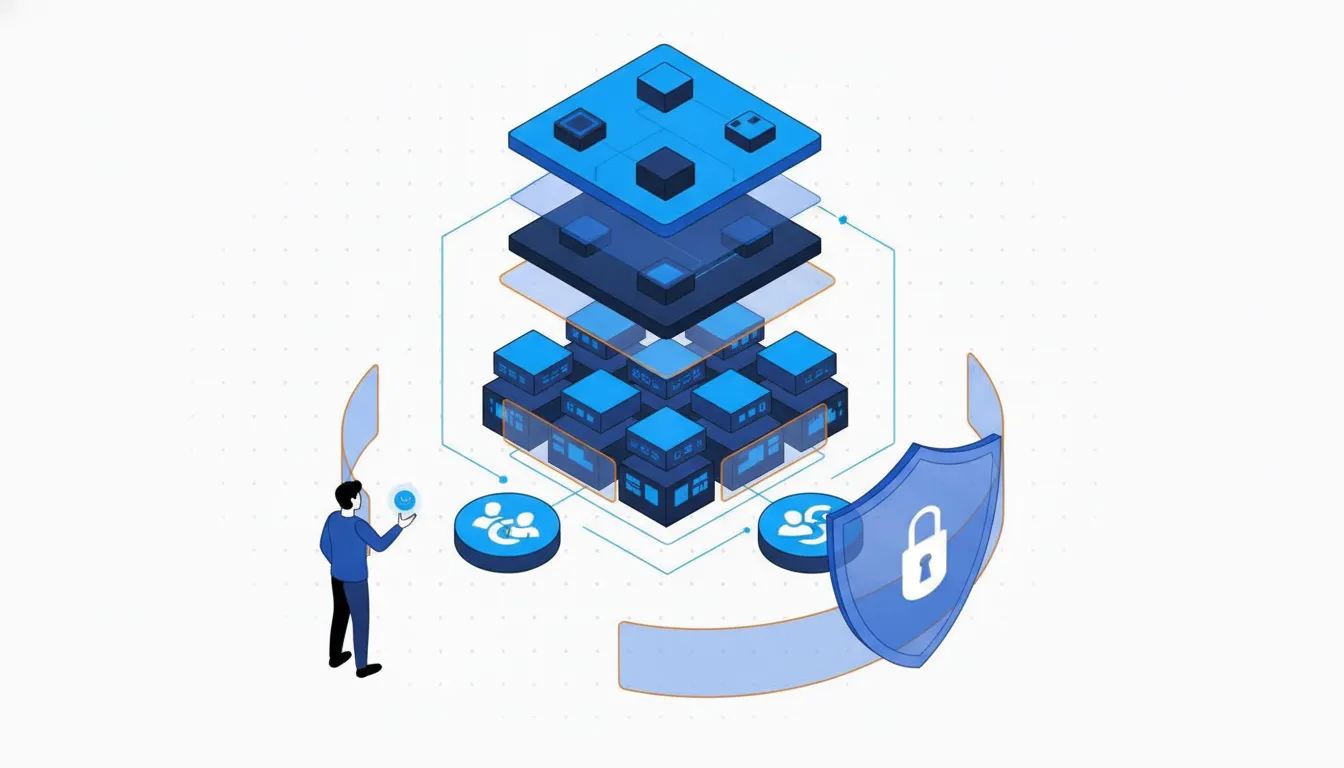
A useful model is to review Kubernetes as a set of interacting control zones:
- Control plane: API server access, authentication, authorization, admission, audit logs, and datastore protection.
- Identities: human users, service accounts, workload identity federation, cloud roles, tokens, and break-glass access.
- Workloads: container images, pod security context, Linux capabilities, secrets, host access, and runtime behavior.
- Networks and services: ingress, egress, east-west traffic, service exposure, DNS, load balancers, and metadata endpoints.
- Cloud boundary: IAM, security groups, managed Kubernetes settings, storage, registries, and connected control-plane services.
The OWASP Kubernetes Top Ten adds a useful risk-oriented lens. Its 2025 list includes insecure workload configurations, excessive permissions, secrets failures, weak policy enforcement, insufficient network segmentation, exposed components, vulnerable cluster components, cluster-to-cloud lateral movement, broken authentication, and inadequate logging. Use it to structure coverage, not to claim that checking ten boxes proves a cluster is secure.
What should a Kubernetes security review cover?
A complete Kubernetes security review covers the cluster, the workloads inside it, and the external systems that can reach or be reached from it. The scope should include configuration evidence and safe validation of realistic attack paths. It should also state what is out of scope, such as destructive testing, production changes, or unapproved access to tenant data.
1. Cluster and control-plane exposure
Start by identifying every control-plane and management interface. Review whether the Kubernetes API, kubelet API, etcd, dashboards, admission webhooks, and cloud-provider endpoints are reachable from the public internet or broad internal networks. Confirm that TLS is used appropriately, certificates are managed, and administrative endpoints are restricted to approved sources.
Then review the control plane's security configuration. Key questions include:
- Which authentication providers are enabled, and are stale users or long-lived tokens still active?
- Are authorization decisions enforced through least-privilege RBAC rather than broad cluster-admin grants?
- Are admission controls used to reject risky pod specifications before deployment?
- Are audit logs enabled, retained, protected from tampering, and sent to a monitored destination?
- Are managed-cluster defaults understood, including provider-specific identity and networking behavior?
Kubernetes recommends combining appropriate authorization controls with node restrictions and carefully designed policies. Treat the provider's defaults as inputs to verify, not as proof that the cluster is secure.
2. Identity, RBAC, and service-account permissions
Identity review is often where a configuration list becomes an attack-path analysis. Inventory human groups, service accounts, cluster roles, role bindings, cloud identities, and automated deployment principals. Map each identity to the resources and verbs it can use. Pay special attention to permissions that can create, update, patch, or delete workloads, impersonate another identity, read secrets, exec into pods, or modify admission and networking controls.
Do not stop at the name of a role. Ask what the permission enables. The ability to create a pod can become a path to host access when the namespace permits privileged containers, host mounts, host networking, or unsafe capabilities. The ability to update a deployment can become a path to run an attacker-controlled image. The ability to read a secret can expose credentials that unlock a second system.
Review service-account token behavior and workload identity. Prefer short-lived, narrowly scoped credentials, disable automatic token mounting where a workload does not need it, and separate identities by application and environment. For cloud access, verify that a pod can obtain only the cloud permissions required for its job. Static cloud credentials embedded in manifests, images, or environment variables should be treated as an urgent exposure.
3. Workload and container hardening
Inspect the pod specifications that actually run, not only the deployment templates that engineers intended to use. Review whether workloads run as non-root users, block privilege escalation, drop unnecessary Linux capabilities, use an appropriate seccomp profile, and avoid host namespaces and host-path mounts unless there is a documented need.
Use Pod Security Standards as a baseline. The Restricted standard is designed for stronger isolation, while Baseline blocks known privilege-escalation patterns without requiring every workload to meet the most restrictive profile. Apply policy at the namespace level and roll it out deliberately through audit, warn, and enforce modes where appropriate. Exceptions should be explicit, owned, time-limited, and tested.
Image security belongs in the same review. Check image provenance, registry permissions, digest pinning, base-image maintenance, vulnerability response, and whether production workloads can pull from untrusted registries. A vulnerability in an image is not automatically exploitable, and a clean image scan does not prove runtime safety. Combine image findings with exposed ports, reachable services, identity permissions, and actual application behavior.
4. Secrets, configuration, and admission policy
Kubernetes Secrets provide an API object for confidential configuration, but they are not a complete secrets-management strategy by themselves. Confirm encryption at rest for control-plane data, access controls around secret reads, audit coverage, rotation, and whether sensitive values appear in source repositories, Helm values, CI logs, container layers, crash dumps, or application output.
Review ConfigMaps and environment variables for accidental disclosure, unsafe defaults, and credentials passed to containers that do not need them. Check whether deployment pipelines can change security-sensitive fields without review. Admission policies should prevent common failures before they reach the cluster, including privileged containers, host mounts, unapproved registries, missing resource limits, and public service exposure where it is not intended.
Policy should be tested against the exceptions teams depend on. A rule that blocks production during an emergency will be bypassed. A rule that is so broad it allows every deployment provides little protection. The right control is enforceable, observable, and accompanied by a safe exception process.
5. Network segmentation and service exposure
Map ingress, egress, and east-west traffic. Identify which namespaces and pods can communicate, which services are reachable from outside the cluster, and whether workloads can access cloud metadata endpoints or sensitive control-plane services. A default-deny posture can reduce unintended reachability, but policies must cover both ingress and egress and be validated against the CNI implementation in use.
Review LoadBalancer services, NodePort usage, ExternalIPs, ingress controllers, service meshes, DNS, and internal administrative endpoints. Confirm that authentication and authorization are enforced at the application layer as well as at the network layer. Network reachability is not authorization. Conversely, an authorization check is less useful when an endpoint is exposed to an unnecessary population.
Test segmentation safely with approved, non-destructive requests. The objective is to prove whether a workload can reach a destination it should not, not to flood the network or extract customer data. Capture the policy, source identity, destination, result, and evidence needed for the owner to reproduce the finding.
6. Cloud and external attack paths
Kubernetes rarely exists in isolation. Its nodes, identities, registries, load balancers, storage, databases, queues, and observability systems often belong to a broader cloud environment. Review the trust relationships between the cluster and those services. Look for paths that begin with a public application, move through a workload, obtain a cloud identity, and reach a high-value resource.
That is where a cloud security review or penetration test can add value beyond a static Kubernetes configuration audit. The assessment should connect asset discovery, identity analysis, configuration review, and controlled attack-path validation. It should distinguish a theoretical permission from a path that is reachable under the agreed rules of engagement.
Penti's public materials describe cloud penetration testing across major cloud environments, agentic discovery, risk prioritization, and human validation. They also reference cloud and container security capabilities. Exact Kubernetes scope, cluster connectivity, credentials, deployment model, and testing limits should be confirmed for the environment before a statement of coverage is made. This article does not assume that every Penti engagement includes a Kubernetes-specific module or direct access to a production cluster.
See how Penti combines AI-driven testing with human validation
How to run a defensible Kubernetes security workflow
A defensible Kubernetes security workflow moves from authorized discovery to configuration review, attack-path validation, risk prioritization, remediation, and retesting. Each stage should produce evidence that another engineer can review. The workflow should be repeatable across environments, but it should not assume that every cluster has the same provider, network model, workload sensitivity, or business impact.
- Define scope and rules of engagement: Name clusters, accounts, namespaces, applications, test windows, approved identities, prohibited actions, data-handling rules, and escalation contacts. Separate production validation from destructive or intrusive testing.
- Build an asset and identity inventory: Record control-plane endpoints, nodes, namespaces, workloads, images, services, ingress routes, service accounts, role bindings, cloud identities, registries, and connected data stores. Mark internet exposure and business criticality.
- Review effective configuration: Evaluate the running state and provider settings. Compare effective RBAC, pod security, network policy, admission, secrets, logging, and image controls with the intended baseline. Capture exceptions and their owners.
- Model realistic attack paths: Start with approved entry points and test whether a low-privilege identity or compromised workload can reach a forbidden action, namespace, node, cloud role, secret, or data store. Validate impact with the least intrusive evidence possible.
- Prioritize by business risk: Combine reachability, privilege, exploitability, data sensitivity, blast radius, detection quality, and remediation confidence. Do not let a high CVSS score alone decide the order.
- Remediate and retest: Apply the smallest safe change, record the owner and deadline, and retest the original path. Confirm both that the finding is closed and that the change did not break required workloads or create a new exposure.
The output should be more useful than a list of misconfigurations. For each material issue, show the affected resource, the effective permission or setting, the plausible attack path, the business consequence, the recommended fix, and the evidence from retesting. This format helps platform engineers act and helps security leaders explain why the order of work is defensible.
How should Kubernetes security findings be prioritized?
Kubernetes security findings should be prioritized by the most credible path to material impact, not by configuration severity in isolation. A reachable privilege-escalation path from an internet-facing workload to a cloud role may outrank an isolated image vulnerability with no reachable service. Risk decisions should be evidence-based, documented, and tied to asset and data criticality.
| Priority factor | Questions to ask | Evidence to capture |
|---|---|---|
| Exposure | Can an external or low-trust actor reach the entry point? | Ingress, service, firewall, and network-policy path |
| Privilege | What can the identity or workload do after access? | Effective RBAC, service-account, cloud IAM, and pod context |
| Blast radius | Would compromise affect one pod, a namespace, a node, or multiple accounts? | Trust boundaries, shared identities, mounts, and reachable assets |
| Data impact | Could the path expose credentials, customer data, or sensitive control-plane records? | Data classification and confirmed access scope |
| Detection | Would the organization see and respond to the activity? | Audit events, alerts, retention, and response ownership |
| Fix confidence | Can the change be made safely and proven closed? | Change plan, owner, rollback, and retest result |
Use severity labels to communicate urgency, but preserve the reasoning behind them. A finding with moderate technical severity may deserve immediate work when it affects a regulated workload or a customer-facing control. A severe issue may be scheduled after compensating controls are verified and the affected asset is isolated. The important outcome is a clear, repeatable decision process.
Common Kubernetes security mistakes to avoid
The most common Kubernetes security mistakes are not exotic. They are ordinary permissions and exposure decisions that become dangerous when combined. A practical review should look for these patterns and test whether they create a reachable path to impact.
- Granting cluster-admin for convenience: Replace broad access with namespace-scoped roles, separate deployment and runtime identities, and review permissions periodically.
- Allowing privileged workloads by default: Enforce Pod Security Standards, block unnecessary host access, and document narrowly scoped exceptions.
- Assuming private means safe: Internal endpoints still need authentication, authorization, segmentation, monitoring, and protection from compromised workloads.
- Leaving service-account tokens everywhere: Disable automatic mounting where it is not required and use workload identity patterns with least privilege.
- Relying on image scanning alone: Pair image provenance and vulnerability review with runtime configuration, network reachability, identity permissions, and exploit validation.
- Using a broad allow-list network model: Start from intended communication paths, apply default-deny controls where practical, and test both ingress and egress.
- Ignoring the cloud boundary: Review how pods obtain cloud credentials and whether a cluster compromise could reach storage, queues, databases, or management APIs.
- Skipping retesting: A configuration change is not a closed finding until the original path is tested again and required behavior still works.
When should you use a Kubernetes security assessment?
A Kubernetes security assessment is most valuable before a major production launch, after a cluster or identity architecture change, during a compliance evidence cycle, after a material incident, or when teams cannot explain the effective permissions and network reachability of critical workloads. Continuous monitoring can identify drift, while periodic human-led testing validates the attack paths that automation may not connect.
Choose the assessment depth based on the question you need answered. A configuration review may be appropriate for baseline drift and policy coverage. A cloud security assessment can connect Kubernetes to provider IAM and external assets. A penetration test adds controlled validation of whether an attacker can move from an approved entry point to a meaningful impact. High-risk environments often need all three, sequenced so that known configuration failures are addressed before deeper testing.
Before engaging a provider, ask for clarity on cluster access, authenticated versus unauthenticated testing, production safeguards, cloud-account scope, data handling, operator experience, human validation, reporting, and retesting. The right deliverable should help engineers remediate and give leadership evidence that the most important paths were tested, not merely that a tool produced findings.
Discuss a cloud security testing scope for your environment
Frequently asked questions
What are the four Cs of Kubernetes security?
The four Cs are cloud, clusters, containers, and code. They describe the layers that must work together: the cloud infrastructure and identities, the Kubernetes control plane and configuration, the container images and runtime settings, and the application code running inside workloads. The model is useful for organizing coverage, but attack paths often cross all four.
How can I secure a Kubernetes cluster?
Secure a Kubernetes cluster by restricting API access, enforcing least-privilege authentication and RBAC, applying Pod Security Standards, managing secrets safely, limiting ingress and egress, protecting images and admission controls, enabling audit logs, and continuously validating realistic attack paths. Start with an authorized inventory and effective configuration review before choosing remediation priorities.
What is the difference between Kubernetes security and container security?
Container security focuses on image provenance, software vulnerabilities, runtime isolation, and the behavior of individual containers. Kubernetes security includes those concerns but also covers the control plane, API authorization, service accounts, namespaces, admission, network policies, service exposure, cluster operations, and cloud identities. A secure image can still run in an insecure cluster.
Are Kubernetes Secrets encrypted by default?
Kubernetes Secret objects are designed to hold sensitive configuration, but teams must verify how their cluster stores and protects them. Review encryption at rest for control-plane data, access permissions, audit logging, rotation, backups, and accidental disclosure through repositories, manifests, logs, images, or environment handling. Do not treat the object type alone as a complete secrets-management control.
How often should Kubernetes security be tested?
Test continuously for configuration and asset drift, and perform deeper assessments after significant changes to clusters, identities, networking, workloads, or cloud accounts. Periodic human-led validation is also useful because it can connect separate weaknesses into an attack path. The right frequency depends on change rate, exposure, regulatory obligations, and the business impact of a compromised workload.
Sources and further reading
Use the following primary references to extend this guide and adapt controls to your Kubernetes version and provider:
