-White.avif)
-Color.avif)
Best Burp Suite Alternatives in 2026: 10 Tools Compared
Burp Suite is the industry standard for manual web application pentesting. PortSwigger's own pages explain why teams still search for alternatives. Burp Suite Professional costs $499 per user. PortSwigger recommends 16GB of RAM for general work, and 4 cores with 32GB for large automated scans. The free Community edition has no vulnerability scanner, ships a demo version of Intruder, and cannot save project files.
None of that is hidden. It reflects what Burp is: a hands-on toolkit built for skilled security testers. Many teams comparing Burp Suite alternatives simply need a different kind of tool:
- Pentesters and bug bounty hunters want the same manual proxy workflow in a lighter, modern toolkit, or in a free open-source one.
- Engineering teams want automated scanning that runs in CI/CD on every deployment, with no manual proxy work at all.
- Teams without a security specialist want pentest-grade findings and compliance evidence without building an in-house security function.
This guide compares 10 alternatives across those three paths. Every fact is verified from each tool's official site. For each tool you'll see who it's built for, real pricing, and what actual users say on G2 and Trustpilot. By the end, you'll know which fits your workflow: hands-on proxy work, developer-first scanning in CI/CD, or AI-driven pentesting validated by experts.
What Is Burp Suite?
Burp Suite is a web application security testing suite built by PortSwigger. It comes in three editions: Community (free, manual only), Professional ($499 per user, hands-on testing), and enterprise DAST (automated CI/CD scanning, custom price). At its core sits an intercepting proxy that works as a man-in-the-middle between the browser and the target application, letting testers inspect and rewrite live requests. That model defines how hands-on web pentesting is done, and it is what the alternatives below either replicate or deliberately replace.
Why Look for a Burp Suite Alternative?
As teams move toward continuous testing, developer-driven security, and API-heavy applications, Burp's manual-first design starts to show its limits.
Burp Suite holds a 4.8/5 rating on G2 from 129 reviews, and reviewers most often praise it for its ease of use and quick setup, its user-friendly interface, and its deep automation and manual testing capabilities. Read alongside Burp's own edition structure, the same reviews also surface the reasons teams look for alternatives:
- Cost scales per user. Burp Suite Professional is a per-user subscription at $499, and PortSwigger states a subscription cannot be shared between multiple users, so five testers means five subscriptions. On G2, expense is a recurring complaint.
- The free edition cannot automate. PortSwigger positions Community as an essential manual toolkit, so any team that needs automated scanning or saved projects has to move up to a paid edition.
- Automated CI/CD scanning is a separate, enterprise-priced edition. Professional is a hands-on desktop toolkit. PortSwigger places automated DAST scanning and CI/CD integration in its enterprise DAST edition, which is quote-based rather than a fixed $499 seat.
- It is built for manual, hands-on work. Burp's core is an intercepting proxy between the browser and the target application. Teams whose workflow is developer-driven rather than hands-on pentesting may not need a manual proxy at all.
- Performance slows on heavier workloads. On G2, reviewers report slow performance, particularly on low-spec systems and during resource-intensive scans. PortSwigger's own system requirements recommend 16GB of RAM for general work and 4 cores with 32GB for intensive tasks such as large automated scans.
- The learning curve is steep for beginners. G2 reviewers describe a steep learning curve that is challenging for those new to the tool.
Pain points above are drawn from PortSwigger's own documentation and from an analysis of verified user reviews on G2.
None of this makes Burp Suite a weak tool. It remains widely used for manual penetration testing, and parts of its ecosystem are hard to replace: Burp Collaborator detects invisible vulnerabilities through out-of-band application security testing (OAST), the BApp Store offers hundreds of community-written add-ons, and PortSwigger's Web Security Academy is a free online training center for web application security. If your workflow is hands-on manual pentesting, those are reasons to stay. But as teams move toward automated, API-heavy, developer-driven security testing, their needs and Burp's manual-first strengths start to pull in different directions, and that is the moment to compare alternatives.
Burp Suite Alternatives Compared
Every tool below solves a different part of the problem for teams that have outgrown Burp Suite's manual-first workflow. Yes, Penti is first on this list. This is our blog and our platform. Every other tool here earned its place by the same criteria we apply to ourselves: Does it fill a real gap in the market? Can the facts be verified from the tool's own site? Is it actually used by teams building today?
Feature Comparison
Legend: ✔ native (built in, no third-party plugin), ✖ not available, ~ limited or partial. Text cells state the method or license as published by the vendor.
Best Burp Suite Alternatives in 2026
1. Penti: Modern Continuous Penetration Testing (AI-Accelerated)
Overview
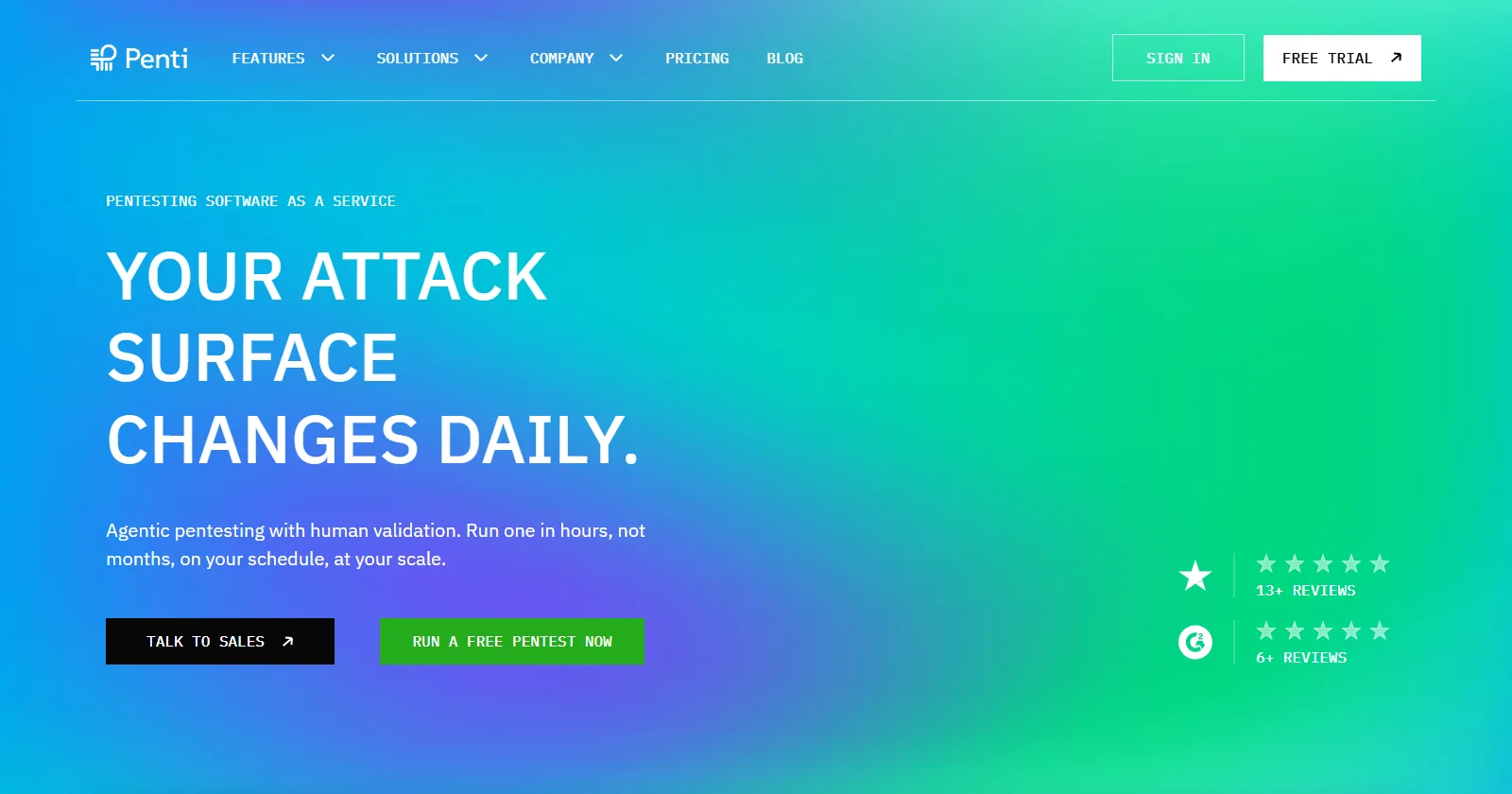
Penti is a modern penetration testing platform that delivers pentest-grade results in hours instead of months. Where Burp Suite is a hands-on manual toolkit, Penti automates vulnerability discovery using AI agents trained on the same methodologies manual pentesters use (OWASP, PTES), then routes every finding through review by certified pentesters. Rather than fully replacing manual pentesting, Penti enables continuous, on-demand testing between your annual compliance pentests, turning pentesting into an accessible service instead of a months-long vendor engagement.
Key difference vs Burp Suite: Burp is a manual toolkit that a skilled tester operates. Penti is a platform that runs the pentest for you: AI agents do the testing, and certified pentesters review the results. Penti knows the Burp workflow from the inside: its sample pentest report lists supplementary scanner analysis with Burp Suite, ZAP, Nuclei, and OpenVAS as a standard testing phase, followed by manual validation and exploitation.
Key features
- AI-accelerated pentesting: AI agents run reconnaissance, scanning, and exploitation using established frameworks (OWASP Top 10, OWASP Testing Guide, PTES, NIST SP 800-115)
- Full attack surface coverage: web apps, APIs, networks (external/internal), cloud, mobile, IoT, LLM systems, and infrastructure
- Expert validation built-in: AI testing backed by human review at every stage, with a reported 70% reduction in false positives
- Unlimited continuous retesting: run tests on your schedule (once, weekly, monthly, or daily), not on a vendor's calendar
- Risk-prioritized reports: remediation roadmaps and compliance mapping in every report
- Compliance framework mapping: SOC 2, ISO 27001, PCI DSS, HIPAA, GDPR, NIST, and CMMC standards
- CI/CD and workflow integrations: Jira, GitHub, GitLab, Slack, and Jenkins, plus compliance platforms (Vanta, Drata)
- On-prem deployment: available on every plan
- Manual pentesting credits: escalate to certified pentesters for specialized testing on any plan, from $4,000 per credit
- Fast onboarding: add targets and run the first pentest in hours, not months of scoping and scheduling
Pricing
Penti offers flexible options across continuous and one-time testing:
- Subscription (continuous testing): Launch $300/mo with 300 exploit runs per month, Plus $1,000/mo with 1,000 runs, Advanced $2,000/mo with 2,000 runs; annual billing saves 10%
- One-time pentest: Web App or Mobile App $4,000, Network $16,000 (1 environment, up to 36 IP addresses), Enterprise custom; prioritized findings and PoCs delivered in 7 business days
- Manual pentesting add-on: from $4,000 per credit, available on any plan
- Enterprise: custom pricing, with HIL (human-in-the-loop) verification via credits
Free trial
Yes. Launch a free AI pentest directly without sales friction. The free tier runs 1 test at a time, up to 3 tests per month per business address. You also get a free Security Headers Scan and can book a demo to see the platform in action.
Best for
SaaS teams, growing companies, and engineering orgs that need continuous vulnerability validation without the months-long pentesting cycle. Teams seeking frequent, on-demand testing to complement their annual compliance pentests and keep pace with deployment velocity.
Strengths
- Hours, not months. Onboard targets in hours and run the first pentest the same day: no 3-4 month waiting period for scarce manual pentesters.
- Expert-validated results. Certified pentesters review AI findings at every stage, cutting false positives by a reported 70%, with no need to build an in-house pentesting team.
- Test on your schedule. Run pentests once, monthly, weekly, or daily: your timeline, not a vendor's availability calendar.
- Full attack surface coverage. Web apps, APIs, networks, cloud, mobile, IoT, and LLM systems tested from a single platform without requiring separate tools.
- Track record at scale. Penti reports 620K+ critical vulnerabilities discovered and 3 to 14 days to proof of value.
- Compliance-ready reporting. Findings automatically map to SOC 2, ISO 27001, PCI DSS, HIPAA, GDPR, NIST, and CMMC with per-finding compliance impact.
- Unlimited testing without linear cost. Retest fixes as often as needed: subscription model, not per-test pricing ($15k-$40k per traditional pentest).
- Complements annual pentests. Use for continuous validation and pre-audit preparation between your compliance-required manual pentests.
Limitations
- Not a manual toolkit. No intercepting proxy, Repeater, or hands-on request manipulation: designed for automated testing, not exploratory security research.
- Complements, doesn't replace, manual pentests. Regulatory requirements (government, finance, highly regulated industries) may still require certified manual pentesting from specialized firms.
- Requires live target access. AI agents need running, accessible applications; not suitable for early-stage development or static code review.
- AI agents have boundaries. Complex business logic flaws, creative attack chains, and specialized testing (mobile app internals, embedded systems) may require manual pentesters, available as add-on credits.
- Deeper manual testing costs extra. Subscription plans run agentic AI pentests; dedicated manual (HIL) pentesting engagements are a paid add-on at $4,000 per credit.
Certifications & credentials
- Public trust center at trust.penti.ai (SOC 2 Type II)
- The pentesting team holds OSCP+ and OSCP, CPTS, CEH (Practical), CompTIA PenTest+, AWS Certified Security (Specialty), Microsoft Azure and Google Cloud security certifications, and an elected CREST Pentest Focus Group Subcommittee membership, as listed in Penti's sample penetration test report
- Findings mapped to SOC 2, ISO 27001, PCI DSS, HIPAA, GDPR, NIST, and CMMC
Reviews
Penti holds a 5.0/5 rating on G2 from 6 reviews and a 4.5/5 rating on Trustpilot from 13 reviews.
Recent reviews on G2 and Trustpilot at the time of writing:
"An easy, quick, and effective security solution, backed by an experienced team... Their customer support was overall excellent and made the process a breeze. Through their effort and quality overall solution, we were able to both better secure our product, achieve our compliance goals, and successful pass security review at multiple Fortune 500 companies."
– Verified User in Computer Software, Small-Business, April 2024 (G2)
"Very satisfied and happy with the experience we had with Penti. Pricing is competitive, support is excellent and they are very accessible in terms of addressing any issues / questions that come up. In some cases, we pointed out an issue and it was resolved within 24 hours. Their model fits really well for our needs and allows us to satisfy our compliance needs easily."
– Ilan Berkner, June 2026 (Trustpilot)
"We've used Penti a couple of times for penetration testing and have overall been happy with the result. Communication has been easy and they've always been willing to adapt to any preferences we've had. The one time we pointed out a particular detail could have been handled better by Penti they accepted the feedback without resistance and offered a way to remedy it. That's the attitude that builds lasting partnerships."
– Carl Littke, May 2026 (Trustpilot)
Read reviews on G2 | Read reviews on Trustpilot
2. Caido: Lightweight Web Security Testing Toolkit
Overview
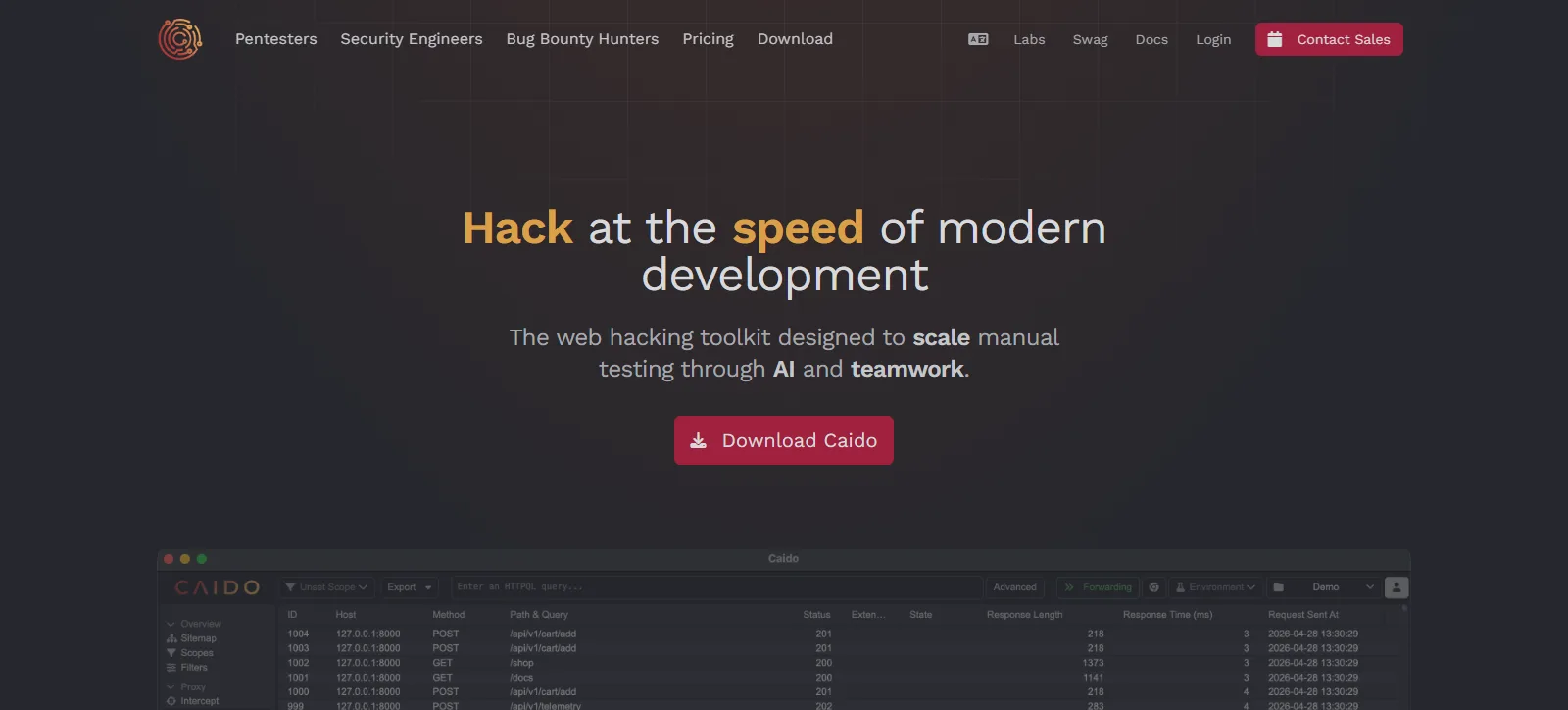
Caido is a web security testing toolkit built around an intercepting proxy, positioned as a modern, lightweight alternative to Burp Suite. Its own tagline calls it "the web hacking toolkit designed to scale manual testing through AI and teamwork." Caido gives testers a fast proxy, HTTPQL search, node-based automation, and AI agents that draft payloads, and it ships as a headless, API-first tool for building custom tooling. It is built for bug bounty hunters, pentesters, and security engineers who want hands-on control without Burp's weight.
Key difference vs Burp Suite: Caido targets the same manual, hands-on workflow as Burp (proxy, replay, request tampering) with a lighter, faster toolkit. It is a rival to Burp itself, not to automated DAST scanners.
Key features
- Intercepting proxy: modern, fast interface for hands-on testing
- HTTPQL: query syntax to search requests and responses
- Node-based automation: workflows built on the fly
- Context-aware AI agents: draft payloads and run tasks
- Headless, API-first design: build custom automation on top
- LLM integration: providers such as Anthropic, Google, OpenAI, and OpenRouter
- Plugin ecosystem: 58+ community plugins
Pricing
- Basic: free forever, up to 2 projects, 7 workflows, 3 plugins, and 5 filter presets, no credit card
- Individual: paid subscription for independent researchers (unlimited projects, workflows, plugins, installations); Caido's own Burp Suite comparison page lists it at $200 per year
- Team: paid, adds shared instances, centralized billing, reassignable licenses, priority support
- Enterprise: custom pricing
Yearly billing saves 16%.
Free trial
Yes. The Basic plan is free forever with no credit card required.
Best for
Pentesters and bug bounty hunters who want a modern, scriptable, lightweight intercepting proxy as a direct hands-on alternative to Burp Suite.
Strengths
- Modern, fast interface and lightweight footprint
- Free-forever Basic tier
- Powerful HTTPQL filtering and node-based automation
- Headless, API-first design for custom tooling
- Growing plugin ecosystem and team collaboration features
Limitations
- A manual proxy toolkit, not an automated DAST scanner, so it does not replace continuous, validated scanning
- No built-in compliance reporting (SOC 2, ISO 27001, and similar)
- Smaller extension ecosystem than Burp's BApp Store
- Team pricing is not published on the pricing page
Reviews
Caido has no G2 or Trustpilot profile yet. The only public numbers are Caido's own: caido.io claims 7,000+ active hackers and a 4,500+ member Discord.
3. OWASP ZAP: Free Open-Source Web App Scanner
Overview
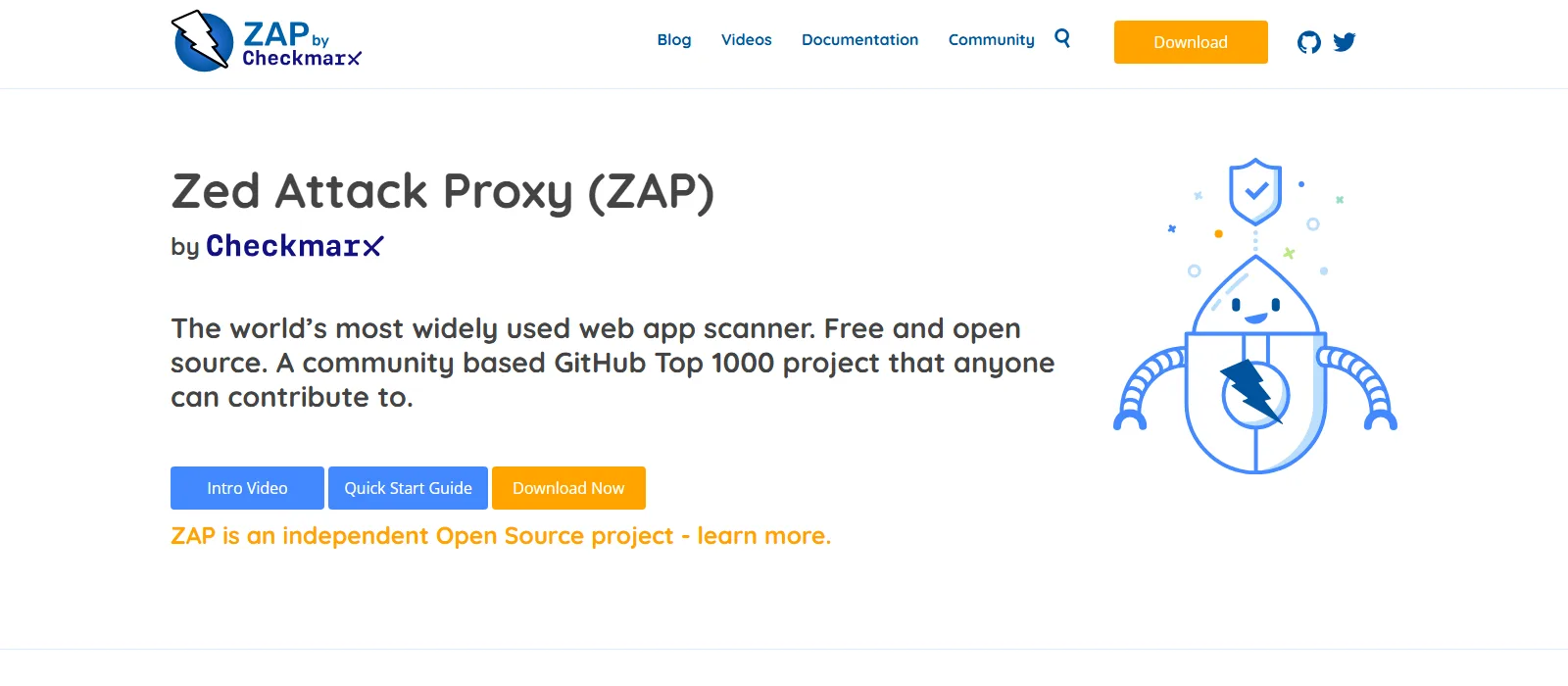
OWASP ZAP (Zed Attack Proxy) is a free, open-source web application scanner that its maintainers call "the world's most widely used web app scanner." Now maintained by Checkmarx as an independent open-source project, ZAP works both as an intercepting proxy for manual testing and as an automated DAST scanner with active and passive scanning. It is designed for newcomers and experienced testers alike, which makes it a common first Burp Suite alternative for teams that want proxy-based testing without a license fee. The project is licensed under Apache 2.0, has 15.6k stars on GitHub, and describes itself as a community-based GitHub Top 1000 project.
Key difference vs Burp Suite: ZAP mirrors Burp's proxy-plus-scanner combination at zero cost. The trade-off is manual false-positive triage and community-level support instead of commercial polish and an SLA.
Key features
- Intercepting proxy: manual request inspection and manipulation
- Automated scanning: active and passive vulnerability scanning (DAST)
- Automation framework: scripted, repeatable scans
- API: integration into CI/CD pipelines and custom tooling
- ZAP Marketplace: community add-ons
- Scripting support: custom checks
Pricing
Free and open-source. There are no paid tiers or license fees.
Free trial
Not applicable. The entire tool is free and open-source.
Best for
Individual developers, students, and budget-constrained teams that want a free proxy-plus-scanner and are comfortable with hands-on setup.
Strengths
- Proxy and scanner in one free package: manual interception plus automated active and passive scanning, under Apache 2.0
- Automation framework and API make it easy to script into CI/CD
- Large community, an add-on marketplace, and 15.6k stars on GitHub
- G2 reviewers value the automated scans and multi-format reports
Limitations
- Expect false positives: findings need manual verification and triage
- G2 reviewers describe the interface as dated and cluttered next to modern tools
- Automated scanning is lighter than commercial DAST platforms
- Setup and tuning take security knowledge to get good results
- Community-supported, with no commercial SLA
Reviews
OWASP ZAP holds a 4.7/5 rating on G2 from 14 reviews (listed there as ZAP by Checkmarx). Reviewers praise its automated scans, easy CI/CD integrations, and open-source model, while common complaints are an outdated interface and false positives that need manual verification.
Recent reviews on G2 at the time of writing:
"I find the automated scans in ZAP by Checkmarx help me save time and offer valuable reports and suggestions. I like that the reports come in different formats, which is really convenient. Also, I appreciate that it's open-sourced, which adds to its flexibility. Plus, the initial setup was very easy."
– AJAYRAJ T., Freelance Software Engineer, Small-Business, May 2026 (G2)
"Support for Active, Passive and Fuzzy scans via Desktop app as well as it can be used via API bindings which can be further integrated in pipelines and can be scheduled as required."
– Verified User in Computer Software, Enterprise, November 2023 (G2)
4. Nuclei: Community-Powered Template Scanner
Overview
Nuclei is a fast, open-source vulnerability scanner maintained by ProjectDiscovery and built on a simple YAML-based template language. Instead of an intercepting proxy, it runs community-contributed detection templates against applications, APIs, networks, DNS, and cloud configurations. ProjectDiscovery counts 12K+ templates created by 900+ contributors, and the open-source project has passed 30,000 stars on GitHub. It is a scriptable, CLI-first scanner that pentesters and bug bounty hunters drop into their workflows and CI/CD pipelines.
Key difference vs Burp Suite: Nuclei replaces neither Burp's proxy nor a full DAST crawler. It is a template engine: you codify checks in YAML and run them at scale, where Burp's strength is interactive, exploratory testing.
Key features
- YAML templates: detection checks written in a simple DSL, easy to reuse and version-control
- Community library: 12K+ templates from 900+ contributors
- Multi-protocol scanning: HTTP, DNS, TCP, SSL, WebSocket, WHOIS, JavaScript, code, and headless browser
- CI/CD integration: vulnerability detection and regression testing in pipelines
- Broad coverage: web applications, APIs, network services, and cloud configurations
- MIT license: free and open-source
- ProjectDiscovery cloud: optional hosted platform with an AI-powered template editor
Pricing
Nuclei is free and open-source under the MIT license. ProjectDiscovery's hosted cloud platform is paid: Pay as You Go starts at $250 (50 credits per seat, top-ups at $5 per credit), and Enterprise is custom-priced.
Free trial
Not applicable for the scanner itself: Nuclei is free to download and run. The ProjectDiscovery cloud pricing page does not list a free trial.
Best for
Pentesters, bug bounty hunters, and engineering teams that want fast, template-driven scanning they can script, extend, and run in CI/CD.
Strengths
- Large, actively growing community template library
- Massive adoption: ProjectDiscovery reports 50M+ monthly scans
- Fast, CLI-first, easy to script and automate
- MIT license with no cost for the scanner
- Multi-protocol coverage beyond HTTP
- Fits CI/CD pipelines for regression testing
Limitations
- Not an intercepting proxy, so no manual request-manipulation workflow
- Detection is template-driven, so coverage depends on existing or custom-written templates
- Command-line tool with no built-in compliance reporting
- Community-supported open source, with no commercial SLA for the OSS scanner
Reviews
Nuclei does not have a standalone G2 profile; its maintainer ProjectDiscovery is listed on G2 for its cloud platform. For community feedback, see the Nuclei GitHub project.
5. StackHawk: Developer-First DAST and API Security
Overview
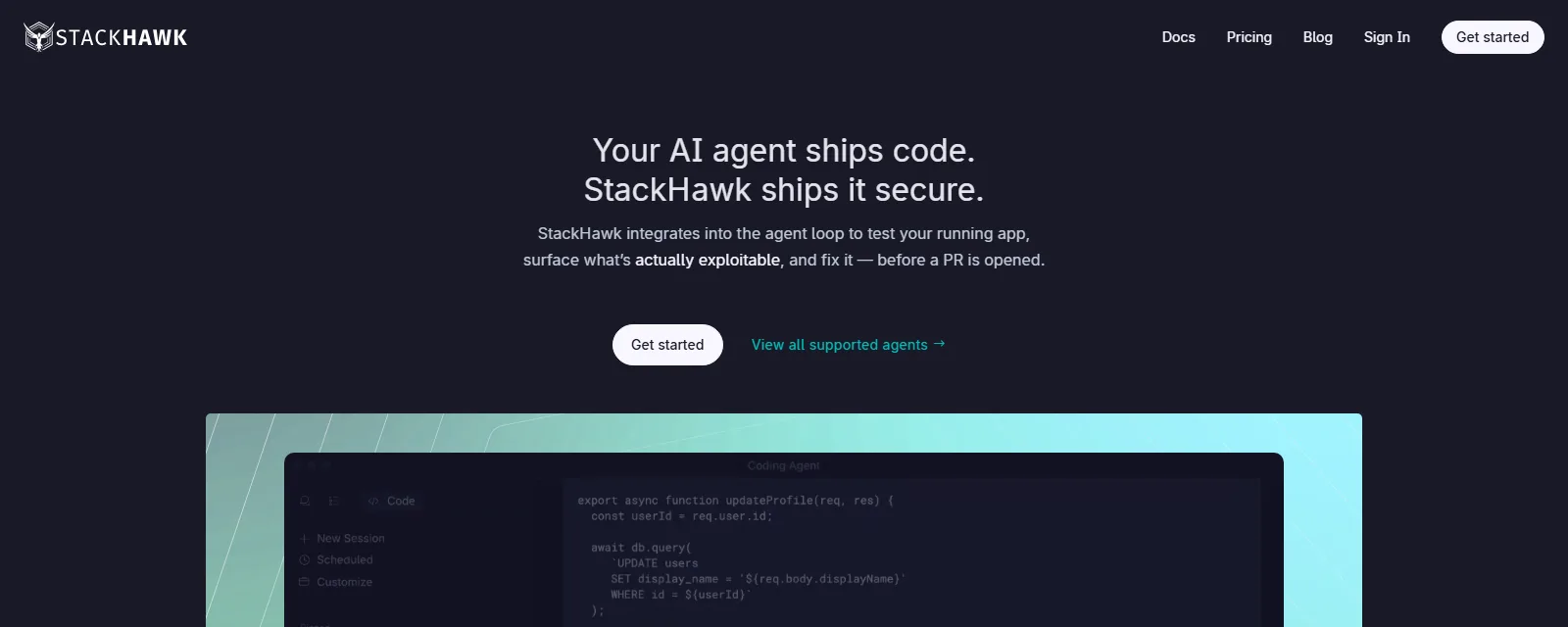
StackHawk is a developer-first DAST (dynamic application security testing) platform. Its tagline, "Your AI agent ships code. StackHawk ships it secure," reflects a focus on catching and fixing vulnerabilities inside the development loop. StackHawk tests your application and APIs while they run, surfacing "only what's actually exploitable," and integrates with AI coding agents such as Claude Code, Cursor, and GitHub Copilot to remediate issues before a pull request is opened. It is a strong Burp Suite alternative for engineering teams that want automated scanning in CI/CD rather than a manual proxy.
Key difference vs Burp Suite: StackHawk replaces Burp's automated scanning inside CI/CD, not its manual proxy. Its HawkScan engine began as a fork of OWASP ZAP, and StackHawk has since reworked its internals into its own HawkScan Test Engine.
Key features
- Runtime DAST: tests the running app and surfaces exploitable issues
- API security testing: REST, GraphQL, and gRPC
- CI/CD integration: tests and fixes before a pull request is opened
- AI-agent remediation: writes fixes in the codebase using full source context
- Automated rescanning: confirms a vulnerability is actually fixed
- AI coding agent support: works with Claude Code, Cursor, GitHub Copilot, Codex, and Antigravity
Pricing
- Wingman: $10 per user per month, with 50 scans per user per month and unlimited apps
- Scale: custom pricing, adding unlimited agentic scans, attack surface discovery, program reporting, enterprise support, and teams/roles/SSO
Free trial
Yes. A 14-day free trial with no credit card required. There is no permanently free plan.
Best for
Engineering and DevOps teams that want automated, developer-first DAST and API scanning inside CI/CD and AI coding workflows.
Strengths
- Developer-first by design: scans run in CI/CD and results land where developers work, not in a separate security console
- Runtime DAST focused on what is actually exploitable, which keeps findings actionable and noise low
- Configuration as code: scan config lives in YAML next to the application, easy to version and reuse
- Transparent entry price: Wingman costs $10 per user per month with 50 scans per user
- G2 reviewers consistently praise the easy CI/CD integration, the documentation, and responsive customer support
Limitations
- Setup can be complex, especially for non-containerized applications (a recurring G2 theme)
- The YAML-based configuration takes time to learn, and G2 reviewers describe a real learning curve
- Automated DAST only: no manual intercepting proxy and no human validation of findings
- No permanently free plan; the 14-day trial is the only free path
Reviews
StackHawk holds a 4.6/5 rating on G2 from 68 reviews. Reviewers praise its easy CI/CD integrations, exceptional customer support, and scanning efficiency, while common complaints are complex YAML setup and a steep learning curve.
Recent reviews on G2 at the time of writing:
"StackHawk embodies a shift-left mentality, allowing us to identify issues earlier in the development cycle, thereby reducing technical debt and enhancing application security... The initial setup was very quick and simple, making it easy to get started and integrate seamlessly with our existing tools like GitHub CodeQL and Jira for handling findings."
– Todd L., Senior Site Reliability Engineer, Enterprise, November 2023, review updated November 2025 (G2)
"Stachawk efficiently performed a comprehensive security assessment, identifying potential issues such as SQL injection, XSS, and security misconfigurations. The detailed reports provided clear insights into each vulnerability, along with recommendations for remediation. Another key feature was its ability to adapt to different environments, making it a versatile solution for both black-box and white-box testing scenarios."
– Verified User in Higher Education, Small-Business, April 2025 (G2)
6. Invicti: Enterprise Proof-Based AppSec Platform
Overview
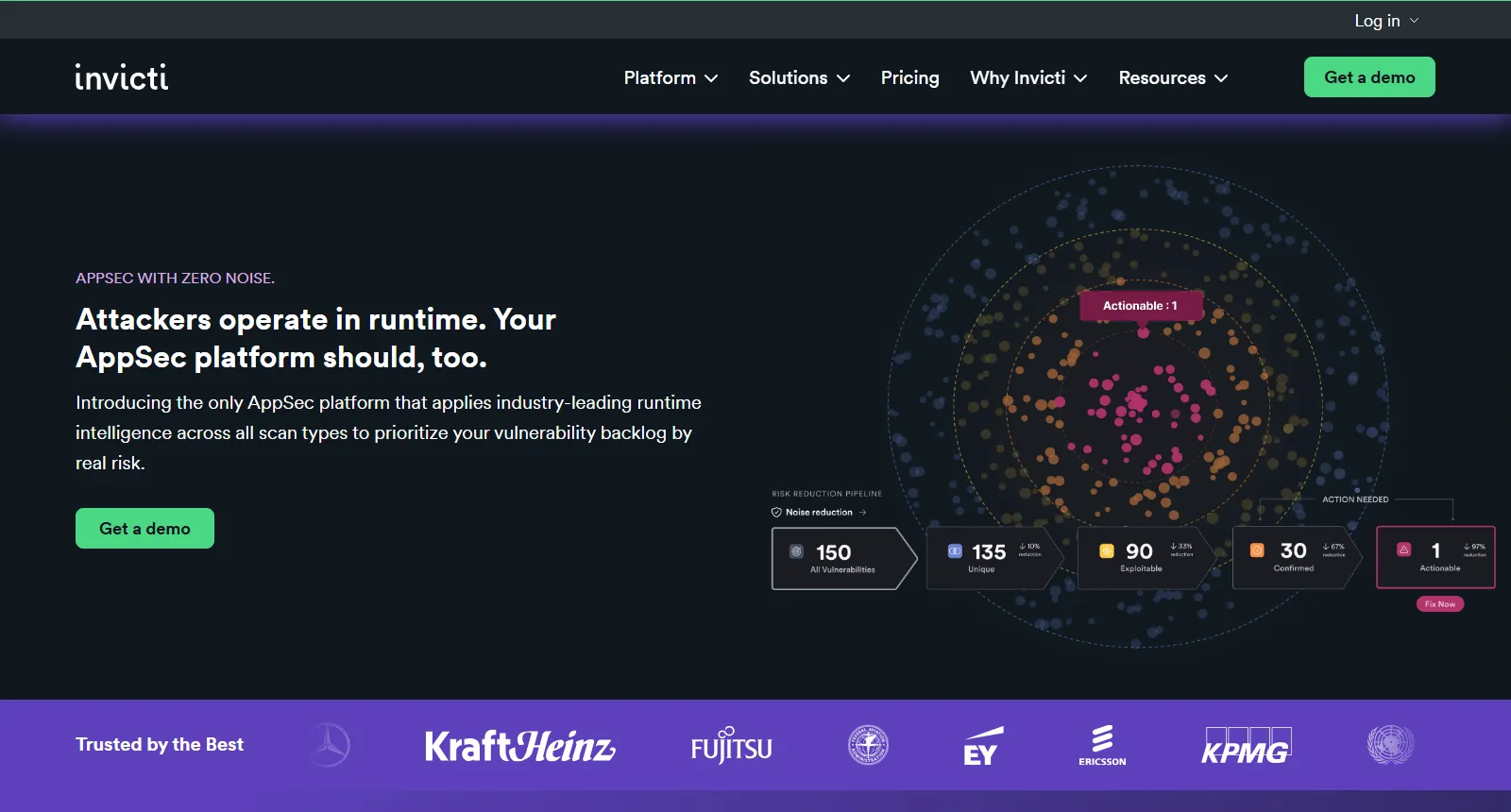
Invicti is an enterprise application security platform built around proof-based DAST. Its tagline is "AppSec with Zero Noise," reflecting a focus on cutting false positives: Invicti advertises proof-based scanning with an "industry-best 99.98% accuracy" that confirms which vulnerabilities are actually exploitable. Beyond DAST, it combines SAST, SCA, API security, and application security posture management in one platform, and integrates with CI/CD to create issues automatically. It is a heavier, enterprise-grade Burp Suite alternative aimed at teams managing large application portfolios.
Key difference vs Burp Suite: Invicti replaces Burp's scanning at enterprise scale: automated, proof-based DAST across hundreds of applications, with no manual proxy workflow at all.
Key features
- Proof-based DAST: confirms exploitable vulnerabilities, with a claimed 99.98% accuracy
- Unified platform: DAST, SAST, and SCA in one place
- API security testing: REST, SOAP, and GraphQL
- Shadow API discovery: finds undocumented endpoints and reconstructs their specs
- CI/CD integration: automated issue creation
- AI-powered remediation guidance: root-cause explanations for developers
- Compliance reporting: executive reports mapped to standards such as PCI DSS, SOC 2, and HIPAA
- ASPM: application security posture management
Pricing
Custom quote. Invicti does not publish pricing and directs buyers to "Get a demo."
Free trial
Demo only. There is no self-serve free trial listed; the site offers a booked demo.
Best for
Large enterprises and DevSecOps teams managing hundreds or thousands of applications that want unified DAST, SAST, and SCA with low false positives.
Strengths
- Proof-based scanning confirms which findings are exploitable, with a claimed 99.98% accuracy that cuts triage time
- One platform covers DAST, SAST, SCA, and API security across large application portfolios
- Shadow API discovery reconstructs specs for endpoints nobody documented
- Compliance and executive reporting mapped to standards such as PCI DSS, SOC 2, and HIPAA
- G2 reviewers praise the ease of use, the quality of scan results, and the DevOps and CI/CD integration
Limitations
- G2 reviewers report slow scans, setup, and upgrades, and some criticize support response times
- Initial setup is complex, especially configuring scans for MFA-protected applications (a recurring G2 theme)
- Quote-based with no public pricing and no self-serve trial: evaluation starts with a booked demo
- Not a manual proxy; nothing here supports hands-on request manipulation
- Built for large portfolios, likely more than a small team needs
Reviews
Invicti holds a 4.5/5 rating on G2 from 72 reviews. Reviewers praise its ease of use, efficient scanning technology, accurate vulnerability detection with excellent DevOps integration, and high-quality reporting for compliance. Common complaints center on slow performance during scans, customer support responsiveness, and complex setup especially for MFA authentication.
Recent reviews on G2 at the time of writing:
"I really appreciate the ease of use that Invicti (formerly Netsparker) offers. The user interface is great, making everything straightforward. The scanning engine stands out for producing high-quality results, especially when compared to competitors. It significantly reduces the manual effort and time needed to perform actions manually. I also found the initial setup to be very easy."
– Zach G., Mid-Market, July 2026 (G2)
"I appreciate how Invicti (formerly Netsparker) automates external pen tests against our public-facing web applications and reports findings to us. It effectively sorts these findings based on priority, severity, exposure, and other indicators... I find the UI to be very navigable."
– Verified User, Mid-Market, July 2026 (G2)
7. Acunetix: Automated Web and API Vulnerability Scanner
Overview
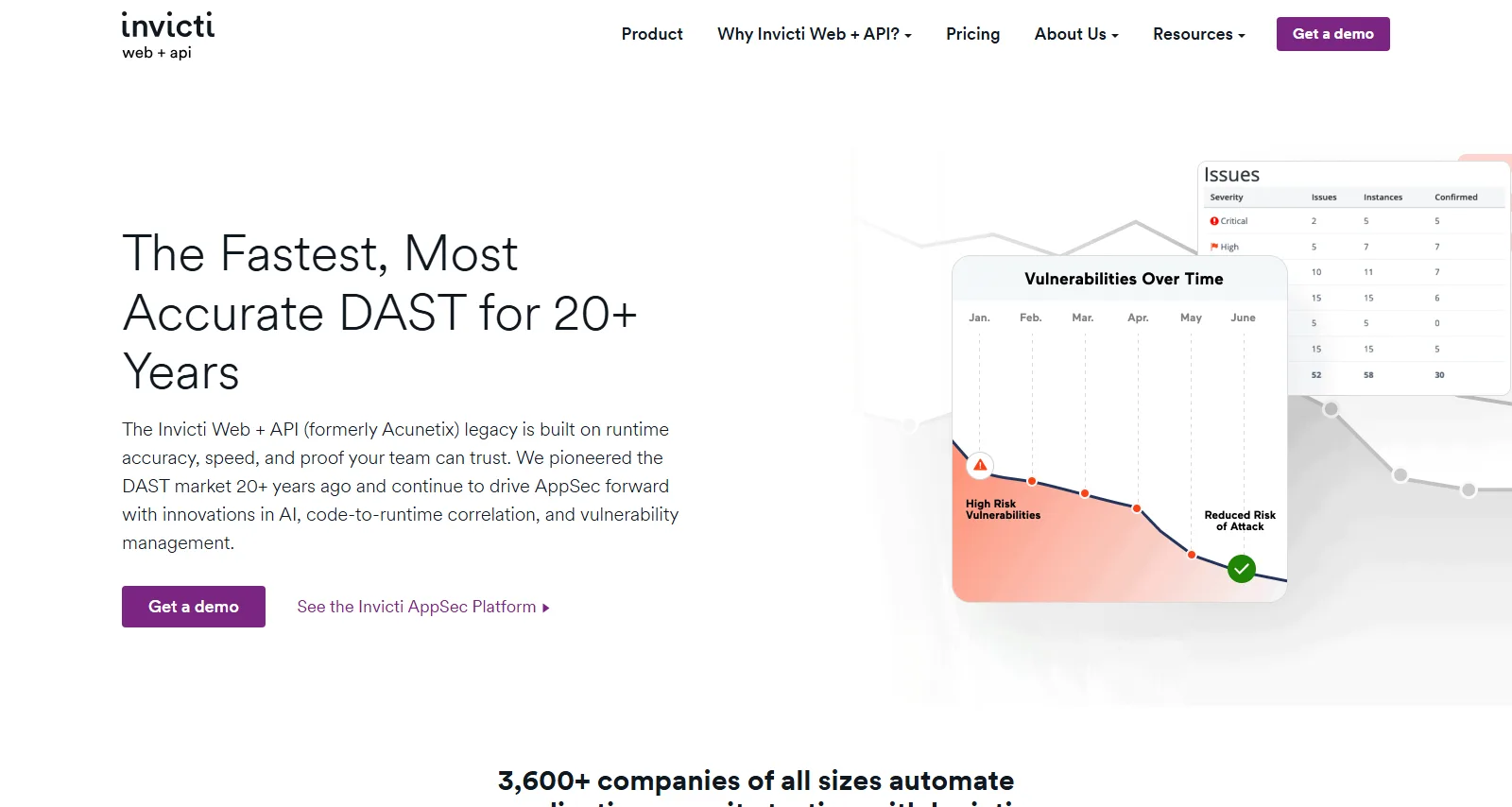
Acunetix is a web application and API vulnerability scanner, and an Invicti product. In its own words, it lets teams "find, validate, and fix exploitable security issues with automated DAST and proof-based scanning." Proof-based scanning confirms which vulnerabilities are actually exploitable, which cuts false positives, and Acunetix detects issues such as SQL injection and cross-site scripting, scans JavaScript-heavy applications, and automates scanning across the SDLC. It is a commercial, enterprise-grade Burp Suite alternative focused on automated scanning rather than manual proxy work.
Key difference vs Burp Suite: Acunetix automates what Burp leaves manual. It is a scan-first product for web apps and APIs, with proof-based validation instead of hands-on request tampering.
Key features
- Automated DAST: web applications and APIs
- Proof-based scanning: validates exploitable vulnerabilities and cuts false positives
- Common flaw detection: SQL injection, cross-site scripting, misconfigurations
- JavaScript app scanning: handles JS-heavy, modern web applications
- CI/CD and SDLC integration: automated, repeatable scanning
- Flexible deployment: on-premises and cloud
- Vulnerability management: tracking and reporting
Pricing
Custom quote. Acunetix does not publish pricing and directs buyers to request a quote or "Get a demo."
Free trial
Demo. The site offers a booked demo rather than a public self-serve trial.
Best for
Organizations that want automated, low-false-positive DAST for web applications and APIs, with on-premises or cloud deployment.
Strengths
- Proof-based scanning validates findings, and G2 reviewers highlight accurate detection with minimal false positives
- Handles JavaScript-heavy applications and APIs, not just static pages
- Detects the most common critical flaws (SQL injection, XSS, misconfigurations) and fits CI/CD and SDLC automation
- Deploys on-premises or in the cloud
- G2 reviewers also credit the ease of use and quick, responsive customer support
Limitations
- G2 reviewers call it expensive, a real hurdle for smaller teams
- Scans get resource-intensive and slow on large applications
- Fine-tuning configurations and integrations takes technical know-how and patience
- Quote-based, with no public price listed
- Not a manual intercepting proxy for hands-on testing
Reviews
Acunetix holds a 4.1/5 rating on G2 from 105 reviews. Users highlight its accurate and fast vulnerability detection with minimal false positives, ease of use, and responsive customer support. Complaints center on high cost (especially for smaller teams), resource-heavy scans of large applications, slow scanning on extensive audits, and configuration that takes effort to fine-tune.
Recent reviews on G2 at the time of writing:
"This is one of the best security tools available on the market today. It continues to evolve and improve. By using it, web applications become more secure. Additionally, it helps identify most hidden pages on any website, especially those concealed through cookies."
– Sai Kiran Narayana, Software Engineer, Enterprise, November 2025 (G2)
"Acunetix by Invicti provides accurate and fast vulnerability scanning with minimal false positives. I like how easy it is to integrate into CI/CD pipelines for automated security testing."
– Verified User in Computer Software, Enterprise, November 2025 (G2)
8. Tenable Web App Scanning: DAST for Exposure Management
Overview
Tenable Web App Scanning is a DAST solution that gives unified visibility into web application and API vulnerabilities. Tenable positions it to identify OWASP Top 10 web application vulnerabilities with automated, scalable scanning, and it is part of the Tenable One exposure-management platform. It is an enterprise Burp Suite alternative aimed at teams that want web app and API scanning inside a broader exposure-management program.
Key difference vs Burp Suite: Tenable WAS trades Burp's depth on a single application for breadth: automated scanning across many applications inside an exposure-management platform, with published per-FQDN pricing.
Key features
- Automated, scalable DAST: web applications and APIs
- OWASP Top 10 coverage: the most common web application vulnerabilities
- Unified visibility: web app and API vulnerabilities in one view
- Tenable One: part of the exposure management platform
Pricing
Tenable Web App Scanning starts at $3,578 per year for 5 fully qualified domain names (FQDNs). The public price configurator covers 5 to 16 FQDNs; larger and multi-year deployments are quoted.
Free trial
Yes. Tenable offers a "Try for free" option for Web App Scanning.
Best for
Enterprises that want web application and API DAST inside a broader exposure-management platform.
Strengths
- Published, predictable pricing (from $3,578 per year for 5 FQDNs), rare among enterprise scanners
- Automated web app and API scanning that scales across many applications with unified visibility
- Part of Tenable One, so web app findings sit next to the rest of your exposure data
- G2 reviewers praise the user-friendly interface, scanning efficiency, and reporting
Limitations
- Cost scales with FQDN count, and G2 reviewers flag overall cost for smaller organizations
- Heavier than lightweight or free tools, with G2 complaints about licensing and configuration complexity
- Not a manual intercepting proxy for hands-on testing
- Most valuable within the Tenable ecosystem
Reviews
Tenable Vulnerability Management (which includes Web App Scanning) holds a 4.5/5 rating on G2 from 126 reviews. Users highlight the user-friendly interface, scanning efficiency, powerful reporting features, and effective vulnerability identification. Complaints often focus on high cost (especially for smaller organizations), limited reporting customization, and platform complexity for licensing and configuration.
9. Metasploit: Penetration Testing Framework
Overview
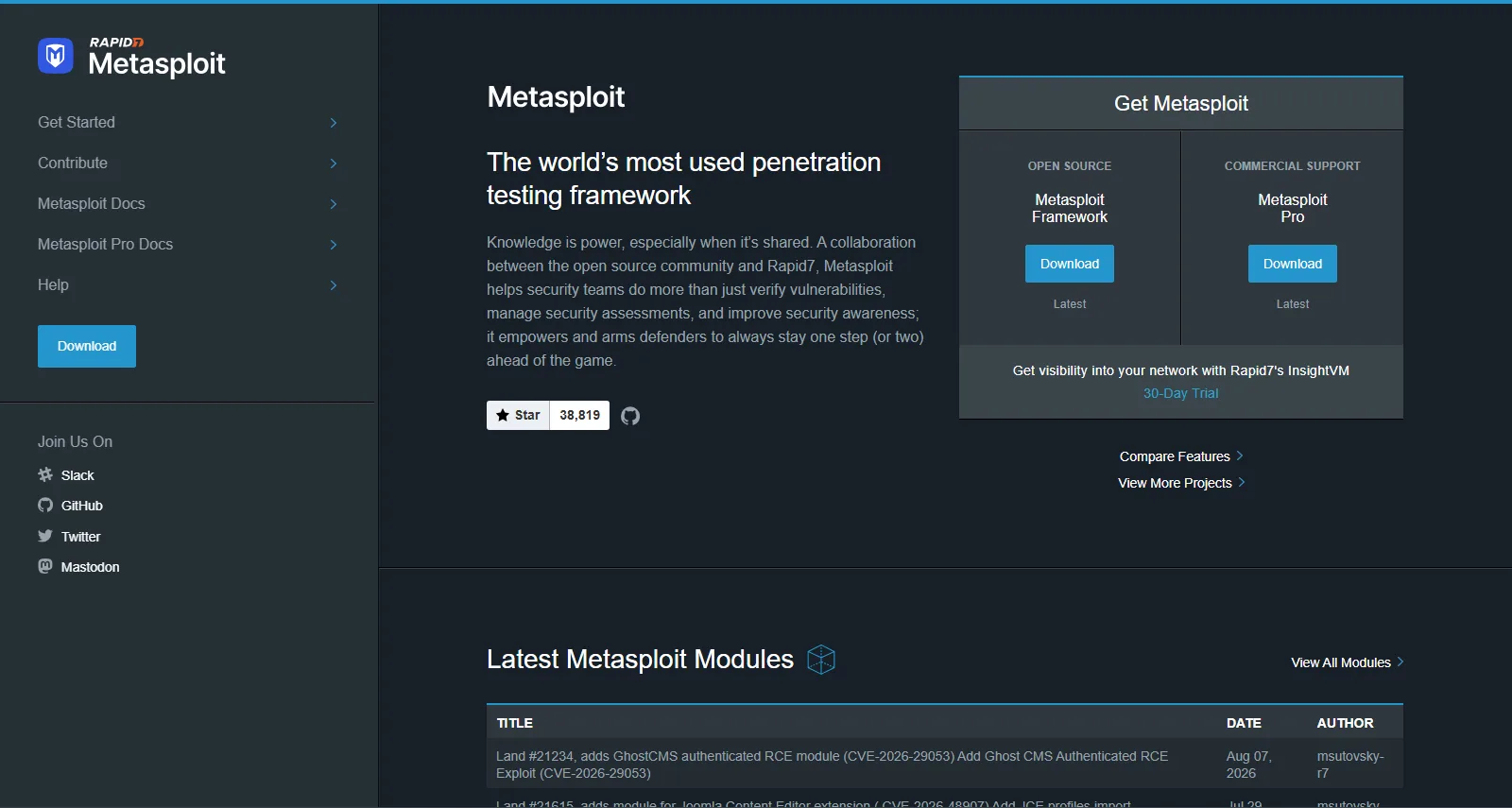
Metasploit is, in its own words, "the world's most used penetration testing framework," maintained by Rapid7. It is an exploitation framework used to find security issues, verify vulnerability mitigations, and manage security assessments, with a free open-source Framework edition and a commercial Metasploit Pro.
Key difference vs Burp Suite: Metasploit is not a web proxy or DAST scanner. It exploits and validates vulnerabilities across networks and systems, so it runs alongside a web-focused tool rather than replacing Burp's web testing.
Key features
- Exploitation framework: large library of exploits and payloads
- Vulnerability verification: confirms findings and tests mitigations
- Assessment management: organizes security assessments
- Framework edition: free and open-source
- Metasploit Pro: commercial edition
Pricing
Metasploit Framework is free and open-source. Metasploit Pro is commercial, with pricing available on request.
Free trial
Yes. The Framework is free and open-source, and Metasploit Pro offers a free trial.
Best for
Penetration testers who need an exploitation framework for network and system testing, used alongside a web-focused tool.
Strengths
- The most widely used penetration testing framework, per its own site
- Large library of exploits and payloads
- Free open-source edition with a huge community (38.8k stars on GitHub)
- Verifies exploitability instead of just reporting suspected vulnerabilities
Limitations
- Not a web application proxy or DAST scanner, so it does not replace Burp's web testing
- A different category of tool from Burp Suite
- Requires security expertise to use well
- Web application testing is not its focus
Reviews
Metasploit holds a 4.6/5 rating on G2 from 55 reviews. Users praise its efficiency, the breadth of payloads it can generate, and how effectively it exploits known vulnerabilities. Complaints focus on a complex setup process and a desire for more automation during installation.
10. Nikto: Free Open-Source Web Server Scanner
Overview
Nikto is a free, open-source web server scanner released under GPL v3. It runs fast checks against web servers for thousands of potentially dangerous files, outdated software, and common misconfigurations. Nikto is a command-line tool, so it does not offer an intercepting proxy or a graphical interface. It is a lightweight, free Burp Suite alternative for quick web server checks rather than full application testing.
Key difference vs Burp Suite: Nikto checks the web server, not the application: a fast CLI sweep for dangerous files, outdated software, and misconfigurations, where Burp tests the application logic behind it.
Key features
- CLI web server scanner: open-source and command-line only
- Server checks: dangerous files, outdated server software, and misconfigurations
- Fast, scriptable scans: easy to chain into scripts
- GPL v3: free and open-source
Pricing
Free and open-source under GPL v3.
Free trial
Not applicable. The entire tool is free and open-source.
Best for
Individuals and teams that want a free, fast command-line web server scanner for quick checks.
Strengths
- Completely free and open-source
- Fast and scriptable
- Good for quick web server checks
- Lightweight, with no license cost
Limitations
- Command-line only, with no proxy or graphical interface
- Higher noise and more false positives
- Not a full web application scanner
- Community-supported, with no commercial SLA
Reviews
Nikto does not have a G2 profile. As a community-supported open-source tool, it does not have formal third-party reviews or ratings. For examples and community feedback, see the Nikto GitHub project.
How to Choose the Right Burp Suite Alternative
The right tool depends on what you test, how your team works, and your budget. Weigh a few factors:
- What you are testing. Web applications and APIs point to DAST tools such as Penti, StackHawk, Acunetix, or Invicti. Hands-on request manipulation points to a proxy like Caido or OWASP ZAP. Network and system exploitation points to Metasploit.
- Manual vs automated. For a manual proxy workflow, choose Caido or ZAP. For automated scanning that runs without a specialist, choose Penti, StackHawk, or an enterprise scanner.
- CI/CD and developer workflow. Teams shipping daily should favor native CI/CD integration, as in Penti, StackHawk, Nuclei, or Tenable.
- In-house expertise. Without a dedicated security team, a platform that validates findings for you (Penti) or a developer-first scanner (StackHawk) lowers the expertise required.
- Budget and pricing model. Free and open-source options include ZAP, Nuclei, Nikto, and the Metasploit Framework. Transparent subscriptions include Penti and StackHawk. Enterprise scanners such as Acunetix and Invicti are quote-based, while Tenable publishes a starting price.
- Compliance needs. For SOC 2, ISO 27001, PCI DSS, or HIPAA reporting, Penti maps findings to those frameworks, and the enterprise platforms also support compliance reporting.
Another way to choose is to start from the symptom your team feels most:
- Releases wait on security sign-off. Prioritize speed and CI/CD-native scanning: StackHawk, Nuclei, or Penti.
- Developers bypass security tooling. Pick a tool that lives where they work, in pull requests and pipelines (StackHawk), or one that runs the testing for them (Penti).
- You drown in false positives. Choose validated results: proof-based scanning (Invicti, Acunetix) or human-reviewed findings (Penti).
- A compliance deadline is coming. Pick platforms with audit-ready, framework-mapped reporting: Penti, Invicti, or Tenable.
- There is no budget. ZAP covers proxy plus scanner, Nuclei covers template scans, Nikto covers server checks, and the Metasploit Framework covers exploitation.
- You miss hands-on control. A modern proxy (Caido) or ZAP keeps the manual workflow alive.
Conclusion
Burp Suite remains a strong manual toolkit for hands-on web penetration testing, but it is not the only option, and for many teams it is not the best fit. If you want continuous, expert-validated testing across web apps and APIs without an in-house team, Penti leads this list. For a modern manual proxy, Caido or OWASP ZAP work well. Development teams that want automated DAST in CI/CD can look at StackHawk, while larger organizations may prefer Acunetix, Invicti, or Tenable. Free options like ZAP, Nuclei, Nikto, and the Metasploit Framework cover specific needs. Choose the tool that matches where your security program is heading.
References
- PortSwigger. Burp Suite. https://portswigger.net/burp
- PortSwigger. Burp Suite Professional. https://portswigger.net/burp/pro
- PortSwigger. Burp Suite DAST. https://portswigger.net/burp/enterprise
- PortSwigger. System requirements. https://portswigger.net/burp/documentation/desktop/getting-started/system-requirements
- PortSwigger. Burp Suite Community Edition. https://portswigger.net/burp/communitydownload
- PortSwigger. Burp Collaborator. https://portswigger.net/burp/documentation/collaborator
- PortSwigger. BApp Store. https://portswigger.net/bappstore
- PortSwigger. Web Security Academy. https://portswigger.net/web-security
- Penti. Pricing. https://penti.ai/pricing
- Penti. AI Penetration Testing. https://penti.ai/features/ai-penetration-testing
- Penti. Pentest Report Generator. https://penti.ai/features/pentest-report-generator
- Penti. Manual Pentest Pricing. https://penti.ai/manual-pentest-pricing
- Caido. Pricing. https://caido.io/pricing
- OWASP ZAP. The ZAP Homepage. https://www.zaproxy.org/
- ProjectDiscovery. Nuclei. https://projectdiscovery.io/nuclei
- ProjectDiscovery. projectdiscovery/nuclei on GitHub. https://github.com/projectdiscovery/nuclei
- ProjectDiscovery. Pricing. https://projectdiscovery.io/pricing
- StackHawk. Pricing. https://www.stackhawk.com/pricing/
- Invicti. Application Security Platform. https://www.invicti.com/
- Acunetix. Vulnerability Scanner. https://www.acunetix.com/vulnerability-scanner/
- Tenable. Web App Scanning. https://www.tenable.com/products/web-app-scanning
- Metasploit. Penetration Testing Software. https://www.metasploit.com/
- Nikto. sullo/nikto on GitHub. https://github.com/sullo/nikto
.avif)