-White.avif)
-Color.avif)
CrowdStrike vs. SentinelOne Comparison for 2026: Key Differences, Features, Pricing, and More
Pick the wrong endpoint platform and you are locked into years of per-device fees, a painful migration, and gaps an attacker can slip through. That is what makes this CrowdStrike vs SentinelOne comparison worth your time: the two names top nearly every analyst shortlist, both rank as Gartner Magic Quadrant Leaders, and both stop ransomware and advanced attacks across laptops, servers, and cloud workloads. They reach that result in very different ways, and those differences reshape your total cost and the daily work of your security teams. This guide cuts through the vendor marketing with a clear look at features, real G2 reviews, and 2026 pricing, then shows where a proactive layer like Penti fits alongside either one.
What Is SentinelOne?
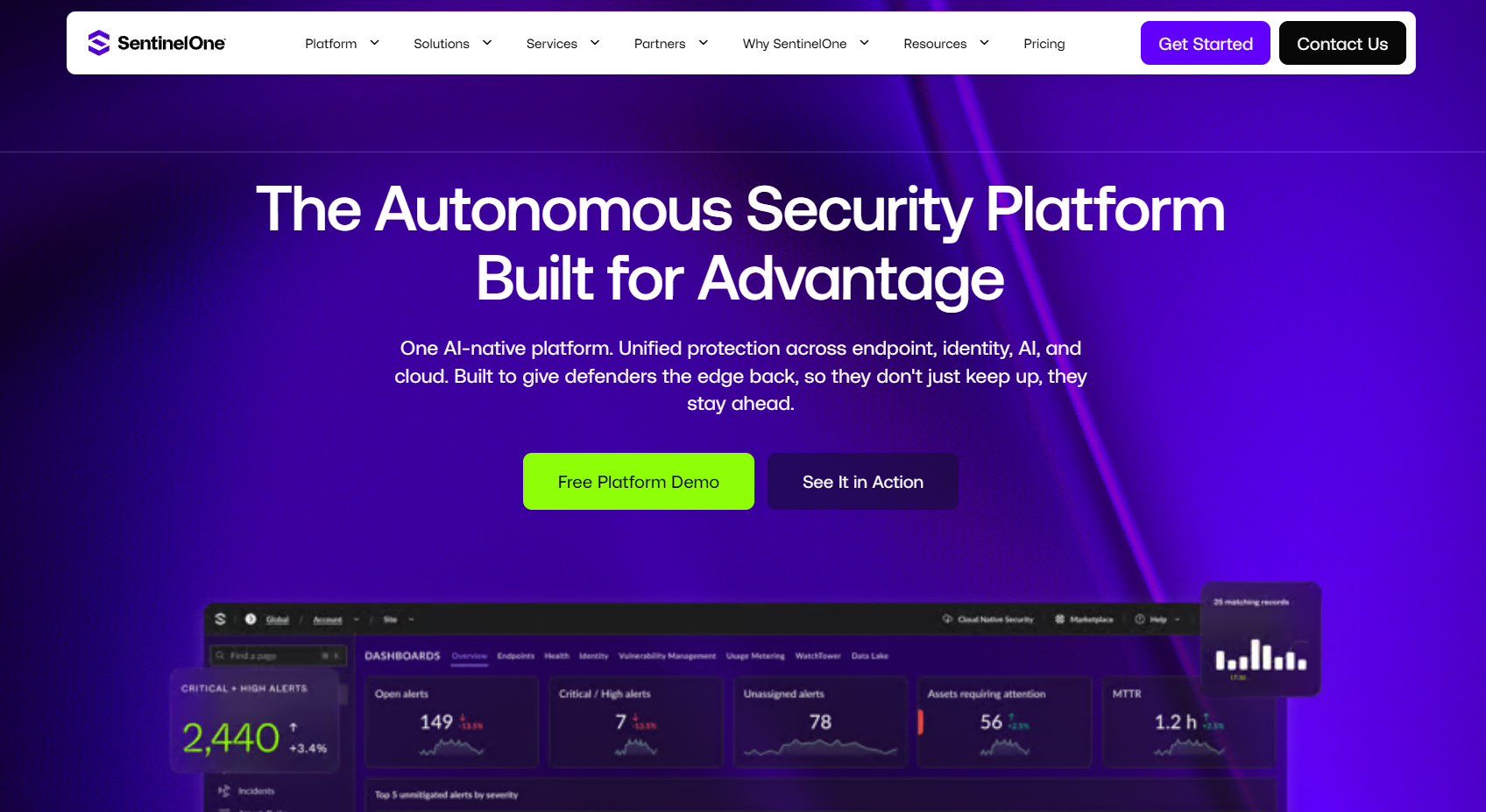
SentinelOne is a cybersecurity company that specializes in endpoint protection, detection, and response. Its core product is the SentinelOne Singularity Platform, described by the vendor as "One AI-Native Platform. Unified Protection. Built for Defenders." The platform protects desktops, laptops, servers, and IoT devices through a single lightweight agent.
The agent uses static and behavioral AI to identify and stop cyber threats such as malware, ransomware, and fileless attacks. Its standout capability is autonomous remediation and rollback: when it detects a threat, it can automatically contain the attack and restore encrypted or altered files to their pre-attack state. Because the AI runs on the device, protection continues when the endpoint has no cloud connectivity.
SentinelOne reports over 11,500 customers, including Fortune 500 and Global 2000 organizations, and is a named Leader in the Gartner Magic Quadrant for Endpoint Protection Platforms. A full breakdown of its modules follows in the Key Features section below.
What Is CrowdStrike?
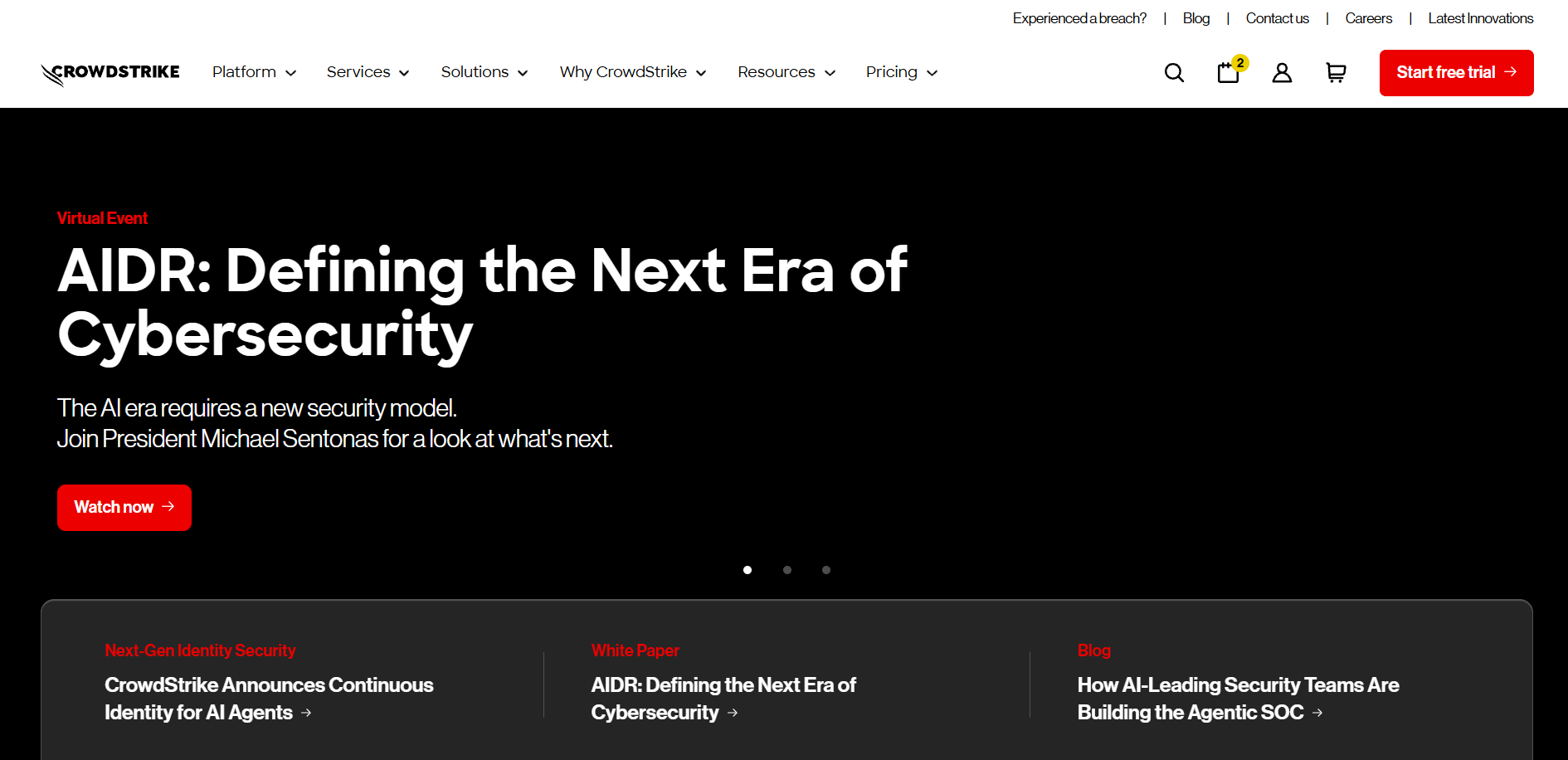
CrowdStrike is a cybersecurity company that provides cloud-native endpoint security, incident response, and threat intelligence. Its flagship product is the CrowdStrike Falcon platform, which the vendor now positions as "Unified Agentic Security" for the AI era. Falcon uses machine learning to detect, prevent, and respond to attacks in real time, covering malware, ransomware, and advanced persistent threats.
The Falcon platform is built around a single lightweight sensor that captures telemetry across endpoints, identity, cloud, and SaaS, then enriches it with intelligence in the cloud. CrowdStrike cites an IDC study claiming a 441% return on investment for Falcon enterprise customers, and it is a named Leader in the Gartner Magic Quadrant for Endpoint Protection Platforms. Its individual modules are detailed in the Key Features section below.
SentinelOne vs. CrowdStrike: Key Differences
SentinelOne leads on autonomous, on-device response and offline protection, while CrowdStrike leads on cloud-scale threat intelligence and managed services. Both are strong endpoint protection platforms, and the right fit depends on your infrastructure, in-house expertise, and budget. Here is the detailed side-by-side across the areas that most often decide the fit.
CrowdStrike vs. SentinelOne Pros and Cons
To ground this in real usage, we read the verified G2 reviews for both platforms and pulled out the themes users raise most.
CrowdStrike Falcon
Pros:
- Lightweight performance: the single agent adds strong protection without slowing systems.
- Threat detection: powerful detection that protects without sacrificing performance.
- Ease of use: simple to run day to day, with an agent that maximizes efficiency.
- Real-time security: advanced real-time protection with no system performance impact.
- Detection accuracy: highly accurate, stopping modern attacks with minimal false positives.
Cons:
- Cost: high licensing price is a barrier, especially for smaller teams.
- Complexity: initial setup and management can be complex for non-technical staff.
- Learning curve: the query language makes quick searches and investigations harder at first.
- Limited features: advanced options need extra licensing, which is costly for smaller organizations.
- Pricing issues: pricing can limit access to advanced features for smaller teams.
Read all CrowdStrike Falcon reviews on G2
SentinelOne Singularity
Pros:
- Tool efficiency: efficient performance with real-time threat detection and a user-friendly interface.
- Ease of use: seamless agent setup and deployment that boosts efficiency.
- Malware protection: effective AI that neutralizes threats effortlessly.
- Incident notifications: an invaluable notification system for easy tracking and effective investigations.
- Feature-rich: broad capabilities and integrations that strengthen the security experience.
Cons:
- Update issues: frequent site updates complicate login and authentication and lower efficiency.
- Learning curve: challenging for beginners navigating the interface and features.
- Frequent updates: agent updates cause login issues and take time to adjust to.
- Agent removal: uninstalling the agent can lead to complications with other applications.
- Ineffective alerts: alerts can fall short, complicating troubleshooting during migration between EDR providers.
Read all SentinelOne Singularity reviews on G2
CrowdStrike vs. SentinelOne Key Features
CrowdStrike Falcon
The Falcon platform is modular, and its core capabilities include the following.
- Lightweight sensor: One cloud-native sensor deploys in minutes and protects every major operating system, giving fleet-wide visibility and seamless scale from a single console.
- Next-generation antivirus: Falcon Prevent combines artificial intelligence, behavioral detection, machine learning, and exploit mitigation to block known and unknown threats. It stops malware, ransomware, and fileless attacks, blocks zero-day exploits, and can kill malicious processes and contain command-and-control callbacks, online and offline.
- Endpoint detection and response: Falcon Insight delivers continuous monitoring and full visibility into endpoint activity, with agentic AI that automates detection triage, investigation, and response. CrowdStrike says this cuts mean time to respond from hours to minutes.
- Identity protection: Falcon Identity Protection defends human and non-human identities against credential-based attacks, adding identity as a front-line detection surface alongside the endpoint.
- SIEM: Falcon Next-Gen SIEM consolidates first- and third-party telemetry for detection, investigation, and response at scale.
- Cloud security: Falcon Cloud Security extends protection and posture management to cloud workloads and infrastructure, unifying cloud detections with endpoint and identity signals on one platform.
- Threat intelligence: Falcon Intelligence delivers threat intelligence feeds, reports, and api access with named-adversary attribution, helping security teams stay ahead of emerging threats.
- Managed threat hunting: Falcon Adversary OverWatch is a 24/7 human-led service whose analysts hunt across endpoints, identity, and cloud for adversary activity that automated defenses miss.
- AI assistant: Charlotte AI, a generative and agentic assistant, triages detections, investigates incidents, summarizes findings, and automates response across the platform.
SentinelOne Singularity
The Singularity Platform is a unified suite, and its core capabilities include the following.
- Endpoint protection: Singularity Endpoint runs static and behavioral AI in a single lightweight agent on the device to prevent, detect, and respond to malware, ransomware, and fileless attacks at machine speed. Protection continues offline, and the agent operates out of kernel space for a more stable, resource-efficient footprint.
- Autonomous response and one-click rollback: The platform automatically contains threats and, with patented one-click rollback, reverses ransomware damage by restoring files and systems to their pre-attack state.
- Storyline: Related events are automatically correlated into a visual attack story, mapping process relationships and MITRE ATT&CK techniques, which lets analysts investigate quickly without rebuilding the timeline by hand.
- Identity protection: Singularity Identity protects human and non-human accounts and helps prevent advanced identity-based attacks against high-value assets.
- Managed threat hunting: WatchTower is a human-led service that targets active global APT campaigns, novel attacker techniques, and emerging trends in cybercrime.
- AI security analyst: Purple AI turns natural language into complex threat-hunting queries, summarizes investigations, and suggests follow-ups, with shared, auditable investigation notebooks.
- Cloud workload protection: Singularity Cloud delivers AI-powered runtime protection for servers, cloud VMs, and containers on the eBPF framework, across AWS, GCP, Azure, and private clouds.
- SIEM: Singularity AI-SIEM ingests native and third-party telemetry into one Singularity Data Lake for detection, hunting, and long data retention.
- Cross-platform coverage: Protects Windows, macOS, Linux, IoT devices, and cloud workloads, suiting hybrid environments that mix modern and legacy systems.
SentinelOne vs Crowdstrike pricing
Headline prices make the SentinelOne vs Crowdstrike cost gap look wider than it is. Both vendors sell bundled tiers priced per endpoint or device per year, where higher tiers build on lower ones. The real difference is how much you buy in a single decision versus assemble over time.
SentinelOne packs more into each tier: a package includes a broad set of capabilities out of the box, which means one choice usually covers you and budgeting stays predictable. CrowdStrike keeps its core bundles leaner and lets you extend them with add-on modules, such as Next-Gen Identity Security and Next-Gen SIEM, purchased at any time, which gives more granular control while the total grows as you add modules.
The figures below come directly from each vendor's 2026 pricing page.
SentinelOne Singularity
Priced per endpoint per year. Its higher tiers build on Singularity Complete.
Singularity Core
Cost: $69.99 per endpoint / year
Key features:
- Endpoint Protection Platform (EPP) with next-generation antivirus
- Role-Based Access Control
- Multi-Tenant Management
Singularity Complete
Cost: $179.99 per endpoint / year
Key features: everything in Core, plus:
- AI-driven endpoint and cloud workload protection
- Real-time threat detection and response
- 14 days of data retention
- AI Security Assistant
Singularity Commercial
Cost: $229.99 per endpoint / year
Key features: everything in Complete, plus:
- Identity Detection & Response (ITDR)
- 90-day data retention
- Managed threat hunting
Singularity Enterprise
Cost: contact sales for pricing
Key features: everything in Complete, plus:
- Agentic AI SOC Analyst for automated triage
- Full Visibility & Forensics
- Expert-led onboarding and training
Note: prices are current as of this article's publication and can change at the vendor's discretion. Check the SentinelOne pricing page for the latest.
CrowdStrike Falcon
Priced per device per year. Each bundle builds on the one before it, and add-on modules can be layered on top.
Falcon Go
Cost: $59.99 per device / year (up to 100 devices)
Key features:
- Next-generation antivirus
- Device control
- Mobile device protection
- Express support
Falcon Pro
Cost: $99.99 per device / year
Key features: everything in Go, plus:
- Firewall management
Falcon Enterprise
Cost: $184.99 per device / year
Key features: everything in Pro, plus:
- Endpoint detection and response (EDR)
- Threat intelligence and hunting
Falcon Complete Next-Gen MDR
Cost: contact sales for pricing
Key features: everything in Enterprise, plus:
- 24/7 managed detection and response
- Identity security and SIEM modules
- Breach Prevention Warranty
Note: prices are current as of this article's publication and can change at the vendor's discretion. Check the CrowdStrike pricing page for the latest.
CrowdStrike starts lower at $59.99 per device and tops its published range at $184.99, while SentinelOne runs $69.99 to $229.99 per endpoint but folds more capability into each tier, with endpoint protection and managed detection appearing at lower, less costly levels than CrowdStrike's equivalents. Add-on modules and the fully managed tiers push the real total higher, and both vendors gate their most advanced options behind "contact sales." That makes a true SentinelOne vs Crowdstrike cost comparison dependent on your device count and negotiated terms.
Independent Testing, Reviews, and Recognition
Both platforms are independently evaluated and carry top analyst recognition. Read the numbers with care, because the punchy percentages on vendor comparison pages are self-selected interpretations, not neutral scores.
MITRE ATT&CK Evaluations
Both vendors have a history in the MITRE ATT&CK Evaluations, which test how well a defensive tool detects real adversary techniques. Read the results with care: MITRE publishes raw detection and protection data and does not rank or score vendors, which means any headline percentage is a vendor's own reading, not an official MITRE verdict. The two also diverge on the latest round. CrowdStrike reports 100 percent detection, 100 percent protection, and zero false positives in the 2025 Enterprise evaluation. SentinelOne did not take part in the 2025 round, but in the 2024 evaluation it reported 100 percent detection with zero delays. Treat both figures as vendor claims.
Analyst recognition (Gartner and Forrester)
Both platforms are named Leaders in the Gartner Magic Quadrant for Endpoint Protection Platforms. SentinelOne cites six consecutive years in the Leaders quadrant, and CrowdStrike was named a Leader for the seventh time in the 2026 Magic Quadrant. CrowdStrike is also a Leader in the Forrester Wave for Managed Detection and Response and for Extended Detection and Response.
User reviews (G2, Gartner Peer Insights, and TrustRadius)
On verified user reviews, both platforms rank at the top of the endpoint protection category. Here is how they compare across the three largest independent review sources, as of 2026.
The two run neck and neck: SentinelOne edges ahead on G2, CrowdStrike on TrustRadius, and Gartner is a tie at 4.7. The score will not pick a winner, but the audience hints at fit. CrowdStrike pulls more reviews on every source and skews enterprise, while SentinelOne skews mid-market. Both clear the bar for a safe choice: over nine in ten Gartner Peer Insights reviewers recommend SentinelOne, and CrowdStrike holds a 2026 Customers' Choice badge for endpoint protection.
Which is better: SentinelOne vs. Crowdstrike
The honest answer to SentinelOne vs Crowdstrike which is better is that it depends on your environment. This is a fit decision, not a quality one. Use the criteria below to place yourself.
Choose SentinelOne if you:
- Run legacy, hybrid, or sometimes-offline machines. Its static and behavioral AI works on the device, which keeps detection and response running with no cloud connection.
- Want the platform to act on its own, with autonomous containment and patented one-click rollback that reverses ransomware damage.
- Prefer more capability bundled into each tier over assembling add-on modules, which keeps budgeting simple for a lean team.
Choose CrowdStrike if you:
- Run a large, cloud-first estate. A single cloud-native sensor gives centralized, fleet-wide visibility that scales across thousands of endpoints.
- Put threat intelligence and adversary attribution at the center of your program, where Falcon Intelligence is a genuine strength.
- Want mature, human-led managed services, from Falcon Adversary OverWatch threat hunting to Falcon Complete MDR.
Bottom line: neither is a risk on capability. The call comes down to your infrastructure, in-house expertise, and budget.
Conclusion
This SentinelOne vs Crowdstrike comparison 2026 is a fit decision, not a contest of quality. Match your environment, in-house expertise, and budget to the criteria above, and either platform will serve you well: SentinelOne for autonomous, offline-capable protection, CrowdStrike for cloud-scale intelligence and managed services. Whichever you choose, detection is one layer of a broader security program. Pairing your EDR with regular penetration testing, to find and fix exploitable weaknesses before attackers do, is what rounds out your defense.
Penti: The Proactive Layer That Completes Your EDR
EDR and penetration testing solve different problems, and they work best together. An EDR such as SentinelOne or CrowdStrike helps detect, investigate, and respond to attacks that reach your endpoints. A penetration test, by contrast, identifies weaknesses before an attacker can exploit them, validates which ones are genuinely exploitable, and helps you remediate them proactively. Neither replaces the other, and neither alone provides a complete security program, which also includes vulnerability management, SIEM and SOC, identity and access management, email security, backup and recovery, and other security controls. Penti is not an alternative to your EDR. It is the proactive testing layer that sits alongside it.
Penetration testing has become hard to skip. Compliance frameworks like SOC 2, ISO 27001, PCI DSS, and HIPAA increasingly expect it, and enterprise customers ask for recent pentest evidence before they sign. The catch has always been the cost of getting it: a traditional pentest takes three to four months to scope and schedule and runs $15,000 to $40,000 per engagement. By the time the report lands, the code has already shipped.
Penti removes that bottleneck. It is an agentic penetration testing platform where autonomous AI agents run real pentest workflows, reconnaissance, exploitation, validation, and reporting, using the same OWASP Top 10 and PTES methodologies human testers use, backed by certified penetration testers. You get pentest-grade results in hours instead of months, from onboarding to audit-ready evidence the same day.
What Penti gives you:
- Real exploits, not a scanner list. Autonomous AI agents execute real exploit chains and confirm what an attacker can reach in your environment, not a pile of theoretical CVEs.
- Results in hours. Launch a test in minutes with nothing to install on your endpoints, and get findings the same day.
- Continuous, on your schedule. Run it once, weekly, monthly, or after every deployment, keeping security in step with your releases.
- Broad coverage. Web applications, APIs, mobile, internal and external networks, cloud, and IoT.
- Certified human validation. Findings are validated by certified penetration testers, with video-evidence exploit replays and a specific fix for each one.
- Audit-ready reporting. Evidence mapped to SOC 2, ISO 27001, HIPAA, PCI DSS, GDPR, NIST, and CMMC, with unlimited retests until findings are closed.
- Fits your stack. Compliance-platform integrations with Vanta and Drata, plus on-demand access to pentesters through Slack.
- Pricing that scales. From $300 per month for unlimited tests, a fraction of a single annual pentest, with a free demo to try it first.
Penti is more than a single test type. Its platform spans agentic AI pentesting, OWASP Top 10 and vulnerability scanning, manual pentesting, red team engagements, and attack surface management, with packages tailored to specific compliance frameworks and to industries from FinTech and healthcare to SaaS and critical infrastructure.
.avif)