-White.avif)
-Color.avif)
Pentest Report Generator: Auditor Checklist
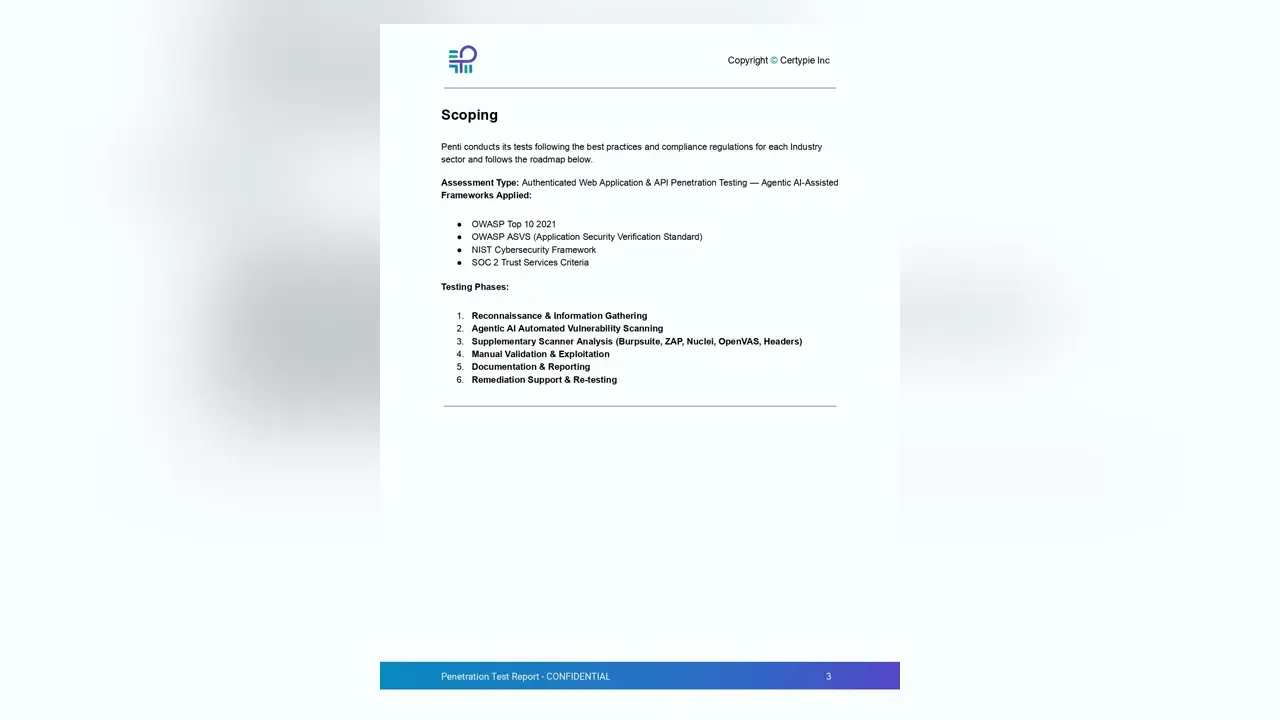
A report can look polished and still leave an auditor asking basic questions. The reader should see what was tested and when. They should also see what evidence supports each finding and what happened after remediation. A useful report answers those questions without burying decision-makers in unexplained scanner output.
Explore a free pentest with Penti
A strong pentest report generator should organize scope, methodology, validated findings, severity, business impact, reproducible evidence, remediation guidance, and retest status. It can make documentation more consistent, but human review still determines whether the evidence is accurate, relevant, and appropriate for the engagement.
That distinction matters because a penetration test report is a point-in-time record, not a certification or a substitute for an auditor's judgment. The clearest way to assess its quality is to start with the reader's perspective: what must be visible, traceable, and easy to verify?
What an auditor looks for in a penetration testing report
An auditor needs to understand what was tested, when it was tested, how the work was performed, and what the results actually demonstrate. A credible report makes those boundaries visible instead of presenting a list of scanner output as proof of security. NIST SP 800-115 describes technical security testing in terms of planning and conducting tests, analyzing findings, and developing mitigation strategies. It also notes that testing can help organizations identify vulnerabilities and verify requirements, while recognizing that no single technique provides a complete security picture. Read the NIST SP 800-115 guidance for the source framework.
- Scope and dates: Identify the applications, APIs, hosts, environments, accounts, and exclusions covered by the engagement. Include the test window and report date so reviewers can distinguish current evidence from a point-in-time assessment.
- Methodology: Explain the testing approach at a level that allows an auditor to understand what was examined, which techniques were used, and where manual validation or judgment affected the result. The report should make clear whether it describes a penetration test, vulnerability assessment, or a combination of techniques.
- Limitations: State what the engagement could not establish. A defined scope, limited test period, unavailable credentials, excluded systems, or non-production environment can all affect how findings should be interpreted.
- Validated findings: Separate confirmed issues from unverified alerts. Each finding should connect the affected asset and observed condition to its security impact, severity rationale, and evidence that a reviewer can examine without relying on an unsupported conclusion.
- Remediation and retesting: Provide a practical corrective action, ownership context where appropriate, and the status of any retest. A closed finding should show what changed and how the organization verified that the issue was addressed.
Good reporting serves more than one reader. Executives need a clear risk summary, engineers need enough context to act, and auditors need traceable evidence and honest limitations. A SOC 2 penetration testing evidence package can support an audit review, but the report itself does not create compliance certification or guarantee an auditor's conclusion.
What a pentest report generator should include for auditors
An auditor needs more than a polished export. A useful report connects the engagement's scope and method to evidence-backed findings. It explains business impact and shows what happened after remediation. The structure should serve different readers. Executives need a concise risk picture, engineers need reproducible detail, and auditors need a traceable record of what was tested and observed.
Core components of an auditor-ready penetration testing report| Report component | What it should answer | What auditors should be able to verify |
|---|---|---|
| Executive summary | What was tested, what matters most, and what action is needed? | The overall risk narrative matches the detailed findings. |
| Scope and dates | Which assets were included, excluded, and tested, and when? | The evidence belongs to the agreed systems and test period. |
| Methodology and limitations | How was testing performed, and what could it not establish? | Conclusions are bounded by the techniques, access, and time available. |
| Findings and evidence | What was observed, where, and how was it validated? | Evidence supports reproducibility without exposing unnecessary secrets. |
| Severity and impact | Why does each issue matter, and how should it be prioritized? | Ratings are explained rather than presented as unexplained labels. |
| Remediation and retest status | What should be changed, and has the fix been checked? | Open, remediated, and retested items are clearly distinguished. |
| Appendices | Where can supporting material and technical detail be reviewed? | References, test notes, and supplemental evidence remain traceable. |
Make the evidence chain explicit
- Executive summary: State the engagement purpose, principal risks, and recommended priorities without overstating certainty.
- Scope and dates: Identify target applications, environments, accounts, exclusions, and the testing window.
- Methodology and limitations: Describe the techniques used and the boundaries of the assessment. NIST SP 800-115 provides guidance for planning technical tests, analyzing findings, and developing mitigation strategies, while noting that no single technique provides a complete security picture: NIST SP 800-115.
- Findings, evidence, severity, and impact: Tie each issue to an affected asset, validation details, practical impact, and a reasoned priority. A scanner alert alone is not the same as a validated penetration-test finding.
- Remediation and retest status: Give an actionable fix, identify ownership where appropriate, and record whether the issue remains open, was corrected, or was verified during retesting.
- Appendices: Preserve supporting notes, references, and evidence in a controlled format. Report length should follow scope, findings, and audience, not an arbitrary page target.
This design supports review without implying that a report itself creates compliance certification. Auditors still evaluate the evidence against the organization's control requirements and the engagement's agreed scope.
How automated report generation reduces documentation time
Documentation often becomes the slowest part of a security assessment when the same details must be copied, reformatted, and reconciled across findings. Structured automation can reduce that repetitive work by applying a consistent report model to approved testing data. Instead of starting each report from a blank document, a team can organize scope, affected assets, severity, evidence, business impact, remediation guidance, and retest status in predictable fields.
The main benefit is consistency, not the removal of expertise. A well-designed pentest report generator can prompt contributors for required context, preserve relationships between related records, and reduce omissions caused by manual transcription. It can also make it easier to produce different views for different readers, such as an executive summary for leadership and detailed finding records for engineers and reviewers. Report length should still reflect the assessment scope, findings, and audience rather than a fixed template or page count.
Automation is especially useful for preserving traceability. Each finding should connect the test action to supporting evidence, the affected asset, the risk interpretation, and the next remediation step. When those relationships remain intact, a reader can move from a summary to the proof and then to the action required. The reader does not need to reconstruct the chain from scattered notes.
Human validation remains essential before delivery. A reviewer should confirm that the finding is real and that the evidence supports the stated impact. Scope and timestamps must be accurate. The recommended action must also suit the environment. Automation can identify missing fields and standardize presentation, but it cannot independently establish whether a result is meaningful in context. Reviewers must also remove duplicates, resolve conflicting details, and distinguish validated findings from unconfirmed signals.
Finally, the report should support the next cycle of work. Clear remediation ownership, retest notes, and retained evidence help teams determine whether a fix addressed the original issue. Penti describes audit-grade report formats, but any platform or internal workflow should be evaluated by the same standard: faster documentation is valuable only when it produces a clearer, reviewable record without weakening human judgment.
Why report structure matters during SOC 2 or HIPAA review
A report is useful in a SOC 2 or HIPAA review when a reviewer can quickly understand what was tested, when it was tested, what the tester found, and how the organization responded. That requires more than a list of vulnerabilities. It requires a traceable record that connects the engagement scope to evidence, risk, remediation, and any later retest.
Start with scope and test dates. Identify the applications, APIs, environments, and other assets included in the engagement, along with material exclusions and the period in which testing occurred. This gives the reviewer the context needed to judge what the results do and do not cover. A penetration test is a point-in-time assessment, so a report should not imply that systems remain unchanged or risk-free after testing ends.
The methodology should explain how findings were identified and validated without burying the reader in unnecessary technical detail. NIST SP 800-115 describes technical testing as a way to plan tests, analyze findings, and develop mitigation strategies, while noting that no single technique provides a complete security picture. A well-structured report therefore makes its testing approach and limitations visible rather than presenting one test as a complete compliance assessment. Penetration testing for SOC 2 can provide additional context on how testing relates to security controls.
Evidence should lead to an action
Each material finding should show the affected asset or condition, the evidence supporting the finding, its security impact, and the recommended remediation. Evidence may include timestamps, relevant requests or responses, validation details, and other material that allows an authorized reviewer to understand how the conclusion was reached. Keep the relationship between the test action, the evidence, the affected asset, and the next step clear.
Remediation status matters just as much as the original finding. Record the owner or action plan where appropriate, then preserve retest results that show whether the issue was corrected. If a limitation, exclusion, unresolved risk, or compensating measure remains, state it plainly.
A pentest report can support an audit or security review, but it does not certify SOC 2 or HIPAA compliance and cannot guarantee auditor approval. Framework mapping depends on the organization's controls, evidence program, and auditor. For broader preparation, see this SOC 2 audit preparation guide.
Common mistakes in pentest reports that fail compliance review
A report can contain technically valid work and still create friction during a compliance review if its context, evidence, or follow-through is unclear. These common gaps make it harder for an auditor, security leader, or engineer to determine what was tested, what was confirmed, and what remains open.
Leaving the scope stale or ambiguous
A report should identify the systems, applications, environments, and test period covered by the engagement. If assets changed after scoping, or the report does not distinguish in-scope from excluded targets, readers may not know whether a finding applies to the current environment. Treat scope as a dated boundary, not a generic description of the company.
Reporting alerts as validated findings
A scanner signal is not automatically proof of exploitable risk. Strong reporting separates an initial observation from a finding that has been reviewed and validated. Include enough evidence for the intended reader to understand the affected asset, the relevant test action, and the result. This distinction is also why vulnerability scanning and assessment should not be presented as interchangeable with penetration testing.
Explaining severity without impact or remediation
A severity label alone does not tell a business what to do next. Each material finding should connect the technical condition to a plausible security or business consequence, then provide remediation guidance that an owner can act on. Avoid vague advice such as "fix the issue" when the report can identify the affected control, configuration, code path, or process that needs attention.
Omitting retest status
A finding that has been marked remediated needs a clear retest status. State whether the fix was tested, when it was tested, what changed, and whether the issue was resolved, reduced, or still present. Without that status, reviewers may confuse an intended remediation with verified closure.
Handling evidence insecurely
Requests, responses, screenshots, credentials, tokens, and other artifacts can contain sensitive information. Do not treat emailing an unprotected report as a sufficient delivery process. Restrict access, remove unnecessary secrets, preserve the evidence needed for verification, and document how sensitive material is handled. A report supports evidence collection and review; it does not by itself create compliance certification.
A practical pentest reporting workflow for security teams
A dependable report is the result of a controlled process, not an export at the end of testing. Use this workflow to keep scope, evidence, decisions, and follow-up connected from kickoff through retest.
- Confirm scope and objectives. Record the in-scope applications, APIs, environments, accounts, test window, exclusions, and rules of engagement. Define what the team needs to learn. NIST SP 800-115 describes technical testing as a process that includes planning, findings analysis, and mitigation strategy development: read the NIST guidance.
- Conduct the agreed testing. Apply the selected methods within the authorized boundaries and preserve enough context to explain what was tested. Testing should produce more than a list of scanner alerts. A useful report distinguishes observations from findings that have been validated and assessed for impact.
- Validate and contextualize findings. Confirm that each issue is reproducible, identify the affected asset and condition, and assess practical impact. Record the evidence that supports the finding, including relevant timestamps, endpoints, request or response details, and other safe-to-share artifacts. Remove secrets and unnecessary personal data before evidence enters the report.
- Generate the report for its readers. Present an executive summary for decision-makers, followed by scope, methodology, severity, detailed findings, evidence, and remediation guidance. Keep technical depth available for engineers while making risk and business impact clear to reviewers. Report length should follow scope, findings, and audience, not an arbitrary page count.
- Complete human review before delivery. A qualified reviewer should check the scope, evidence, severity, wording, remediation advice, and unresolved uncertainties. Human review is also the point to catch duplicate findings, unsupported conclusions, sensitive data, and statements that could be misread as a compliance certification.
- Remediate and retest. Assign owners and priorities, then retest the affected conditions after changes are deployed. Update each finding with its remediation status and retest evidence. Preserve the relationship between the original test action, the affected asset, the evidence, and the next action so a later reviewer can follow the decision trail.
- Preserve evidence securely. Deliver the final report through controlled access, retain only what the engagement and retention policy require, and protect supporting artifacts from casual distribution. Keep the approved report, review history, remediation records, and retest results together so the evidence remains usable for future security reviews.
Explore a free pentest with Penti
Frequently Asked Questions
What should a penetration test report include?
A useful report includes the testing scope, methodology, executive summary, prioritized findings, business impact, remediation guidance, and supporting evidence. It should help an auditor understand what was assessed while giving security and engineering teams enough context to act on the results.
What evidence should each finding contain?
Each finding should connect the affected asset to the observed issue, explain how the result was validated, and show why the risk matters. Evidence examples can include relevant endpoints, timestamps, request and response details, screenshots, validation notes, remediation status, and retest results. Include only the material needed to verify the finding securely.
How long should a penetration test report be?
There is no useful universal page count. The appropriate length depends on the assessment scope, number and complexity of findings, and the needs of the audience. A concise executive summary can sit alongside detailed technical findings and appendices, so decision-makers and engineers can use the same report without unnecessary repetition.
Can an automated report generator replace human review?
No. Automation can improve consistency, organize evidence, and reduce documentation effort, but qualified human review remains important for validating findings, interpreting impact, checking scope, and confirming that remediation guidance is appropriate. The final report should distinguish observed evidence from analysis and recommendations.
Does a pentest report prove compliance?
A report can support an audit by documenting testing, findings, evidence, and remediation progress, but it does not create compliance certification by itself. Whether the documentation satisfies a particular framework or review depends on the organization's requirements and auditor. Confirm the expected scope and evidence format before testing begins.
Get started with a clearer pentest review process
A structured pentest can give your team a more consistent way to organize findings, supporting evidence, remediation, and retesting for review.
