

Building an Application Security Program That Scales
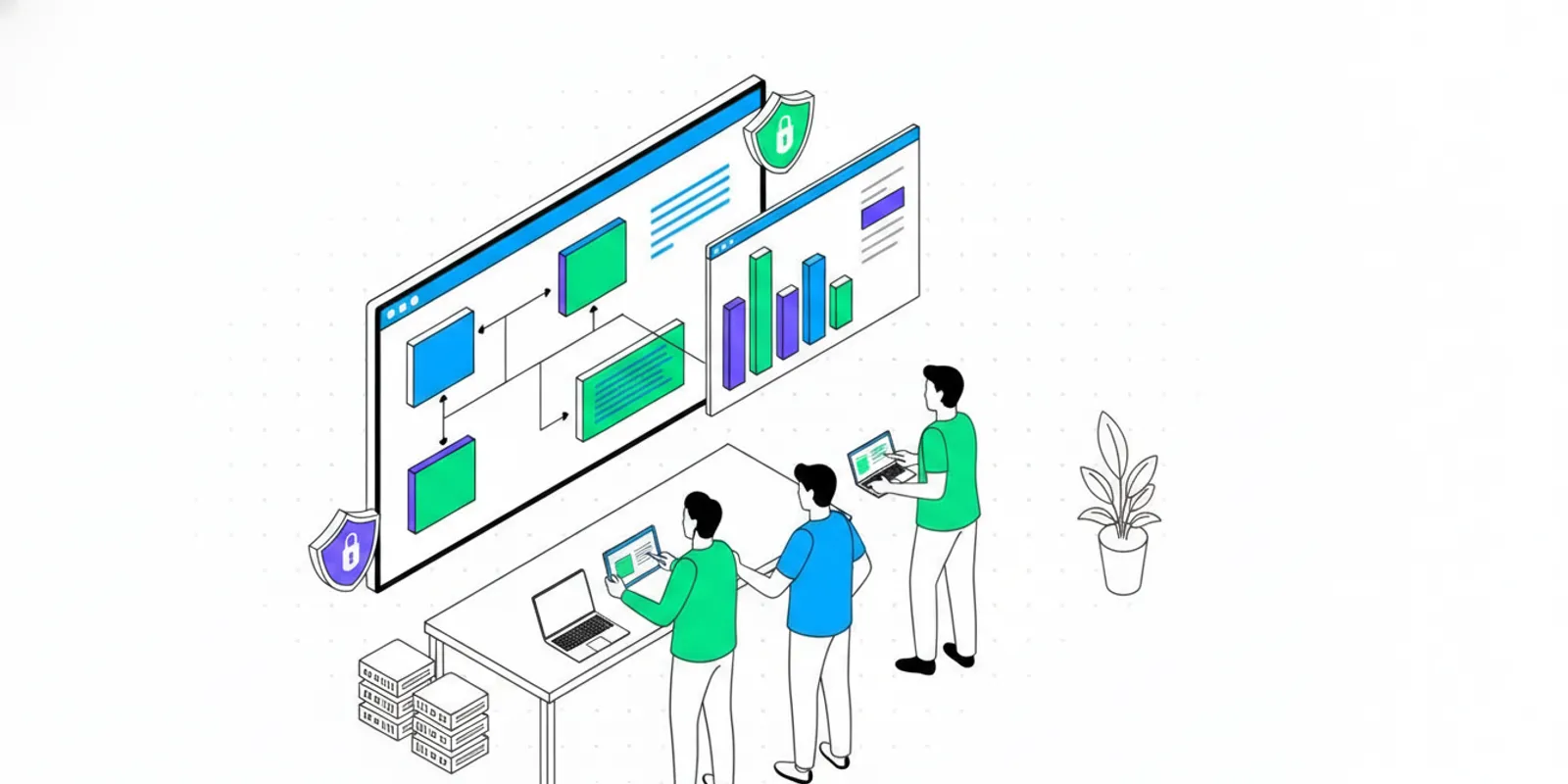
A growing company can build an application security program by assigning ownership, mapping important applications and data flows, prioritizing risks, and combining secure development practices with repeatable testing and remediation. The goal is not to eliminate all risk. It is to make security work visible, consistent, and proportionate to the systems and information the business must protect.
Talk with Penti about application testing
What belongs in an application security program?
An application security program is the set of people, processes, and technical controls used to reduce risk across software design, development, release, and operation. It should connect day-to-day engineering work with business priorities. A growing SaaS company may have web applications, APIs, cloud services, mobile clients, and third-party integrations. A program needs to account for how these parts interact, not just scan source code.
Start with a practical scope. List the applications and services the organization owns or operates, who is accountable for each, what sensitive data they handle, and which systems are exposed to customers or the internet. Include dependencies and key data flows. Keep the list maintainable. A useful inventory is one teams can update as products and architecture change.
Then define how security concerns are found, assigned, fixed, and checked again. A report with no responsible owner or follow-up process is not a program. Teams should know how to raise an issue, who makes priority decisions, how exceptions are documented, and how to verify remediation.
The program also needs an operating rhythm. Decide which activities happen during planning, code review, deployment, and post-release review. Set a recurring meeting or dashboard review for the highest-priority findings. The process does not need to be elaborate at first, but it should make security work visible before a deadline, customer questionnaire, or incident forces a rushed response.
How can a growing company set priorities?
Security teams rarely have enough time to test everything at once. Prioritize based on business context and plausible impact, not a raw count of findings. Consider internet exposure, data sensitivity, privilege, product criticality, known attack paths, and whether a weakness is reachable in the deployed environment.
- Identify critical services. Ask which applications support revenue, customer access, or essential operations.
- Map sensitive information. Note where credentials, personal information, payment data, or confidential business data enter, move, and reside.
- Understand exposure. Record public endpoints, administrative interfaces, integrations, and trust boundaries.
- Use a consistent risk process. Set severity and response expectations that account for exploitability and impact, and document exceptions.
- Revisit priorities. Reassess after major releases, architecture changes, incidents, or new integrations.
A simple risk register can help connect technical findings to decisions. For each important application, record the owner, business purpose, data classification, exposure, authentication model, last meaningful change, and planned testing. This gives leadership a view of coverage and helps engineers understand why one workflow should be addressed before another.
Frameworks and standards can help structure work, but adopting a checklist alone does not demonstrate that an application is secure. ISC2's discussion of building resilient security programs also emphasizes the need to combine strategic direction with ongoing organizational and technical work. Read ISC2's guidance on security programs that scale for additional context. For background on one common web security reference, see Penti's practical guide to OWASP. Teams working toward a broader control structure may also find its overview of cybersecurity frameworks useful.
Which practices should the program include?
Build security into the development lifecycle while preserving a clear path for deeper testing. The right mix depends on the product, architecture, team capacity, and risk. Common practices include secure design review for significant changes, code and dependency checks, secrets management, access controls, configuration review, vulnerability handling, and testing of running applications.
| Practice | What it helps examine | Useful fit | Important limit |
|---|---|---|---|
| Threat modeling and design review | Trust boundaries, abuse cases, and design assumptions | New features, major architecture changes, sensitive workflows | Depends on accurate context and follow-through |
| Static code analysis | Potentially unsafe code patterns and defects | Frequent checks during development | May produce findings that need context and triage |
| Dependency and configuration checks | Known component issues and selected configuration risks | Ongoing changes in repositories and environments | Does not show whether an application can be exploited end to end |
| Dynamic application testing | Behavior of a running application and exposed interfaces | Deployed test environments or authorized production scopes | Coverage depends on scope, access, and test approach |
| Penetration testing | Whether weaknesses can be combined or exploited in scope | Risk-based assessments and meaningful changes | A test is a point-in-time view of defined assets and conditions |
These practices complement one another rather than replace one another. For example, static checks can provide fast feedback in code review, while testing a running application can reveal issues tied to configuration, authentication, or interactions between components. A DevSecOps workflow can help teams place checks where developers can act on the results.
Secure design review deserves special attention because some application risks begin before code exists. Ask what the feature is intended to do, which users and services can invoke it, what happens when a request is repeated or altered, and which trust boundaries are crossed. Document the assumptions that matter. This makes later testing more focused and gives developers a shared reference when requirements change.
Access and secrets controls should be part of the normal delivery process as well. Review how service accounts are created, how credentials are stored and rotated, how administrative functions are separated, and how access is removed. These checks are not a substitute for application testing, but they reduce the chance that a finding depends on a preventable process weakness.
How should findings move from discovery to remediation?
Agree on a consistent workflow before expanding the number of tests. Each finding should have enough information for an owner to understand the affected asset, evidence, potential impact, and recommended next step. Assign it to a team or person, set a priority and target review date, and record the status in a system teams already use.
- Validate and triage. Confirm the issue is relevant to the asset and environment. Resolve duplicates and clarify uncertainty.
- Prioritize in context. Consider technical severity alongside exposure, business importance, and available mitigations.
- Assign ownership. Name the engineering or service owner responsible for remediation and escalation.
- Fix and verify. Retest the relevant behavior or configuration. Keep evidence of the retest and closure decision.
- Look for patterns. Repeated issue types may point to a design weakness, missing guardrail, or training need.
A useful finding should answer several practical questions. What was tested? What behavior or component was affected? What evidence supports the result? What could an attacker do in the relevant context? What is the recommended fix or mitigation? What remains uncertain? This information helps an engineer act and helps a security leader explain the decision to other stakeholders.
Do not treat a closed ticket as proof that risk is gone unless the fix has been checked in the relevant context. Some issues need a workaround or accepted exception instead of an immediate code change. Record the rationale, approver, compensating measures, and review date so the decision can be revisited.
For more on organizing proof and findings, see Penti's guide to what to check in a penetration test report. A report should make it possible to understand scope and evidence, not merely present a list of severity labels.
How does continuous testing fit?
Periodic testing can provide a focused assessment, but application changes and new exposures can occur between engagements. Continuous security testing can add repeated or on-demand checks to a program, particularly when teams release frequently or need to reassess important assets after changes. It does not make every test comprehensive, and it does not remove the need for clear scope, skilled interpretation, and remediation.
When evaluating a continuous testing approach, ask what assets and interfaces are in scope, how often tests can run, what evidence supports findings, how teams retest fixes, and what human review is included. Automated results may need validation and prioritization. Human-validated testing can help distinguish actionable issues from noise and add context, but no testing method can establish that an organization will never be compromised.
Continuous testing works best when connected to change. Define triggers such as a major release, a new public endpoint, a change to authentication, a new integration, or an incident. The trigger should lead to a clear action, such as a focused test, a review of an existing result, or a retest of a fix. This is more useful than running checks without deciding how the results will affect the backlog.
Consider the environment and authorization carefully. Define permitted targets, test accounts, timing, rate limits, and points of contact before testing begins. Ensure the testing plan avoids unapproved systems and has a process for pausing if unexpected operational impact occurs. Penti describes its approach to continuous security testing for SaaS; compare any provider's stated scope and evidence with your own requirements.
What should buyers evaluate in a testing provider?
Choose a provider based on fit and verifiable deliverables, not a broad promise of coverage. Start by describing the application, technology, key workflows, access available, and the decision the test should support. Then compare proposals against the same questions.
- Scope and exclusions: Which domains, APIs, environments, accounts, and user roles are included? What is explicitly excluded?
- Method and expertise: How is testing performed, and what human review or validation is included?
- Evidence quality: Will findings include reproducible steps, affected components, impact, and remediation guidance?
- Workflow fit: Can the team assign findings, track remediation, and request retesting in a practical way?
- Safety and authorization: How are test boundaries, credentials, data handling, and escalation managed?
- Reporting and communication: Will the output explain limitations, assumptions, severity rationale, and unresolved risks?
Ask for a sample report or a walkthrough using a representative finding. Check whether the evidence is understandable to both engineers and decision-makers. Ask how the provider handles a suspected false positive, an issue that cannot be reproduced, or a finding that crosses an application boundary.
It is also worth asking what happens after the report arrives. A testing service can be technically capable and still be a poor fit if findings cannot enter the team's workflow or if retesting is unclear. Confirm the expected communication path, the format of evidence, the process for questions, and the conditions for a follow-up assessment. For a service-specific overview, review Penti's cybersecurity testing offering and confirm directly that the proposed scope matches your assets and objectives.
How can a team measure whether the program is improving?
Choose measures that help leaders make decisions and teams improve the process. Avoid relying on a single metric, such as total findings, since that number can rise when testing improves or scope expands. Pair process measures with context about coverage and risk.
- Percentage of critical applications with named owners and current inventories.
- Coverage of agreed testing activities across important applications and interfaces.
- Time from finding validation to assignment, remediation, and verification.
- Number and age of high-priority findings awaiting action, interpreted in scope.
- Repeat findings that indicate a common root cause or control gap.
- Completion of planned retests after significant fixes or changes.
- Percentage of major product changes receiving the planned security review before release.
Use trends to ask better questions, not to create false certainty. A shorter remediation interval may be positive, but it does not show that all important risks are known. Explain changes in scope, test frequency, and severity criteria when comparing periods.
Review measures at more than one level. Engineers may need actionable information about age, owner, and verification status. Security leaders may need coverage of critical applications and recurring root causes. Executives may need to understand whether important risks are being addressed in line with business priorities. The same underlying records can support all three views if they are kept consistent.
What should the first 90 days look like?
A staged start helps a growing company create a usable program without waiting for a perfect process. The exact schedule should reflect the product and risk, but the following sequence provides a practical baseline.
- Days 1 to 30: Name accountable owners, inventory critical applications, document sensitive data flows and public interfaces, and agree on a finding severity and exception process.
- Days 31 to 60: Review the most important workflows, establish secure development checks, test a representative application or API, and route findings through the agreed workflow.
- Days 61 to 90: Verify fixes, identify repeated issue types, expand coverage based on evidence, and set a recurring review for changes, testing, and open risk.
Keep the first cycle small enough to finish. A completed inventory, clear ownership, useful findings, and verified fixes create more value than a large list of activities that no team can maintain. After the cycle, record what was not covered and why. That limitation is useful planning information, not a reason to hide uncertainty.
Frequently Asked Questions
How should a small security team start?
Begin with an inventory of critical applications, accountable owners, sensitive data flows, and exposed interfaces. Establish a basic finding-to-fix workflow and choose a few risk-based checks that the team can sustain. Expand based on product changes and evidence from the initial cycle.
Is a vulnerability scanner enough for an application security program?
No single scanner covers every type of risk. Scanners can help identify certain weaknesses efficiently, but teams still need context, validation, secure design practices, remediation ownership, and testing suited to the running application and its business-critical workflows.
How often should an application be penetration tested?
There is no universal schedule that fits every application. Consider risk, change rate, exposure, customer expectations, and the purpose of the assessment. Set a repeatable baseline and reassess after significant changes or when new evidence changes the risk picture.
Does continuous testing replace a human-led assessment?
Not automatically. Continuous checks can provide repeated visibility, while human-led assessment can bring contextual analysis and explore paths that depend on judgment. Decide based on scope and objectives, and verify exactly what a provider's service includes.
Discuss a testing plan for your applications
A scalable application security program grows through clear ownership, risk-based testing, useful evidence, and verified remediation. Start with the applications that matter most, make the process repeatable, and adjust it as the product and business change.
